
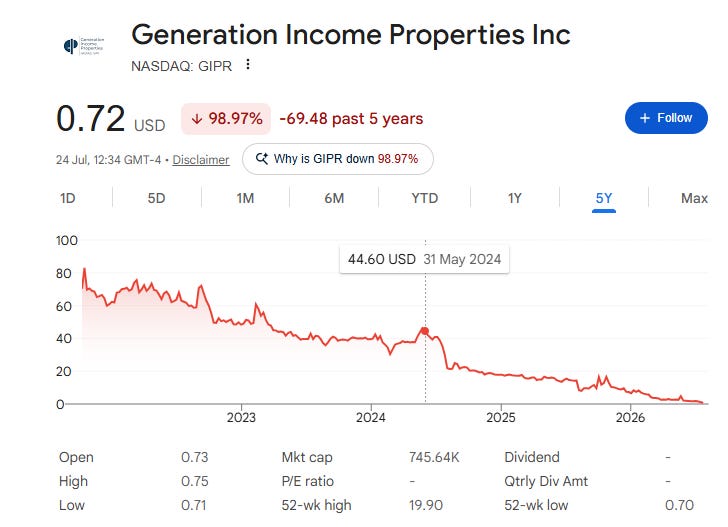
Every so often the market serves up a company trading for less than the cost of the paperwork that created it. When it does, it often just indicates next to zero value, but on a rarer occasion still, it’s an interesting tale. Generation Income Properties (Nasdaq: GIPR) — a Tampa REIT that owns 23 net-leased buildings across the country — is currently valued by the public market at roughly $740,000 (and minus one to two hundred thousand, depending on how you calculate it). Not million. Thousand. That is after a 1-for-10 reverse split two weeks ago, with a formal going-concern warning in the last 10-Q, a Nasdaq delisting deadline of August 4, and a mandatory redemption hammer falling August 10. We are far beyond the point where the writing is on the wall.
Except — and here is what you likely won’t hear elsewhere — the real estate is fine. Better than fine. I went briefly through the filings, did the math a few different ways, and reached a conclusion that flies in the face of the current stock price: this is a perfectly good portfolio. The buildings didn’t fail, and neither did their management. The underwriting, property selection, and property management by the team is more than decent. What failed is everything stacked on top of them.
The Buildings Are Fine. Arguably, Better Than Fine.
The portfolio: 23 single-tenant buildings (24 until they sold one in April), about 468,000 square feet, 100% leased. The tenant roll reads like people’s weekend errands: nine Dollar Generals, a Best Buy, a Kohl’s, a Walgreens, a Tractor Supply, a Starbucks, a Zaxby’s — plus offices leased to the federal government and a pre-K leased to the City of San Antonio. Roughly 60% of the rent comes from investment-grade tenants. These are net leases: the tenant pays the taxes, the insurance, the maintenance. Buildings like this practically run themselves.
Is the value real? Let’s verify it at the simplest and broadest level. One: the books carry the portfolio at $93 million of gross cost (ignore the $15 million of “accumulated depreciation” — in many ways an accounting fiction as the properties do not lose value at that rate; on the contrary they typically appreciate).
Two: the portfolio produces about $7.5 million of base rent and roughly $6.6 million of NOI, which against cost is a 7.1% cap rate — precisely where single-tenant net lease trades in this market. Nobody overpaid here, nor is inflating assets on the books. Three — and this is an important one — in April FIPR actually sold a building, the Dollar Tree in Morrow, Georgia, at a 7.5% cap… fetching a third MORE than its depreciated book value. The market, at least for that building, approved management’s work and assumptions.
So call the portfolio $90 million, an honest number. Against it: $48 million of mortgages — a hair over half, blended around 5.9%, every covenant in compliance. Rental income easily overcomes the operating expenses of the properties. If the story ended there, this would be a boring, solvent little REIT. It doesn’t end there.
So Where Does the Rent Go? Follow the Waterfall.
Here is a quarter of GIPR’s life, in one small table:

Read that carefully. The real estate hands the company $6.6 million a year, and the company still loses a million dollars a quarter. The portfolio is healthy; being strangled by tentacles from the capital stack that funded it, and the management that created it.
Tentacle number one: $3.2 million a year of corporate overhead — to administer 23 buildings where the tenants mow their own lawns. That is after direct property management and maintenance costs. Tentacle number two, the fatter one: the parade of preferred partners collected along the way — the Brown family, JCWC, Bernstein, LMB — each holding “redeemable non-controlling interests” with redemption rights and preferred returns. And towering above them all, the king tentacle: LC2.
Meet LC2 — The 18% Passenger
LC2-NNN Pref, LLC is a vehicle of Loci Capital, an opportunistic real estate fund from — small world — Tampa. These are real estate finance bros apparently, who seem to know what they are doing. In 2023 they wrote a $14.1 million check that let GIPR close its biggest acquisition. The terms tell you they knew exactly who they were dealing with: a 15.5% cumulative return, a 1.3× make-whole, mandatory redemption in two years. When GIPR couldn’t pay on time in 2025, the extension cost a fee and bumped the rate to 18%, compounded monthly.
It is important to the math on what this position has already returned: roughly $8 million collected in cash to date — and they STILL hold a $13.1 million claim, growing about $200,000 every month, with the mandatory redemption due August 10. This single position consumes about 40% of the entire portfolio’s NOI. The folks at Loci priced desperation correctly, which is their business, and gave GIPR the lending hand it was asking for. GIPR accepted what ended up amounting to a parasite that was bound to kill its host.
Why You Probably Can’t Just Buy the Shares (Tempting as It Looks)
Now, some folks will look at a $740,000 market cap and reach for buy button, and I understand. Consider what a Nasdaq-listed REIT shell is worth all by itself: try to create one from scratch and you are looking at a million-plus in SEC and listing fees, a few million more in lawyers and auditors, and one to two years of your life in paperwork. The listing alone is worth several times the current price of the whole company.
So Option One suggests itself: a few folks get together, buy up the shares, take control, a “hostile takeover” (in Hollywood and leftist parlance), and then attempt a negotiation with LC2.
Doable but definitely a gamble. First, the float: is there even enough stock available, and at what price once your own buying affects it? Volume and float numbers seem to indicate it is possible, but hard to tell in practicality. Second, and far more important: control of the common gets you control of nothing that really matters. LC2’s rights are contractual, sitting at the subsidiary level, attached to the best assets, with a redemption hammer and an 18% meter running. If you cannot make a deal with them, the claims above you keep compounding and keep converting — GIPR has already been paying creditors in shares and in entire buildings — and the endgame is that LC2 and friends end up owning most of the company you thought you bought. In which case you didn’t really get the publicly listed company either.
The Elegant Solution: $10–12 Million and Three Signatures
But an outside fund — real money, moving fast — could do something much cleaner, because every player at the table has a reason to say yes.
Pay off LC2, perhaps with a modest discount. They have already collected $8 million; a check for $10–12 million today, against the alternative of litigation and taking the keys to thirteen Dollar Generals, makes them completely whole on a three-year deal with returns their investors will toast. They are happy campers. They can rightly pat themselves on the back on a good opportunity, under the right terms, taken boldly.
Extend the Brown family loan a year — they have extended before, they will take the fee. The CEO? Mr. Sobelman personally guaranteed the “bad-boy” carveouts on the mortgage stack — the guarantees that spring to life precisely IF the company files bankruptcy. A rescue isn’t a threat to him; it is a lifejacket. His cooperation is likely the least complicated in the deal. And it is a vital one.
In exchange: the fund takes for example, 80% of the company. Existing shareholders keep 20%. The latter end up with way more than the near zero wipe out facing them in the face of the LC2 legal claims. Weather it is a violent Chapter 7 or 11, or a slow motion Chapter 11 in the OTC (as GIPR would get delisted from the Nasdaq) without liquidity and taking years as assets sell, the current common share holders stand to be virtually wiped out in the absence of a deal with LC2 and company.
Now, under this elegant and modest bailout, tale a look at the new company. Remove LC2 and you stop $2.3 million a year of bleeding. Cut the corporate overhead in half (must be a requirement for Management that buried the healthy portfolio under a deadly capital stack, and entirely doable for a portfolio of self-running net leases), and save another $1.6 million. That is a $4 million annual swing: the company is profitable.
Net value to the common, after every mortgage and every remaining preferred: roughly $17–18 million. The fund’s 80% is worth more than it paid on day one — plus a listed platform it can grow. The old shareholders’ 20% is worth several times today’s entire market cap. The balance sheet swings positive, which — a pleasant bonus — cures the Nasdaq deficiency in the same stroke. Every single party ends up better off than its next-best alternative, which is often the defining factor of a deal that you know will close.
The clock, however, is ticking and merciless: Nasdaq’s deadline is August 4, LC2’s hammer falls August 10. Whoever wants this has days, not months. Be it an individual or group of individuals that chance buying the shares (and with margin it takes a couple of hundred thousand dollars at most) in the open market (and/or ask for Proxies), or some folks that go straight to the Fulcrum, LC2 and make a deal, the interesting opportunity is there.
The buildings will be fine. They have been, even throughout the tumultuous recent past. The only question is who will own them when the music stops.
Great analysis. Will be interested to learn how it turns out