
Article format of original thread posted on Dec 8 2025
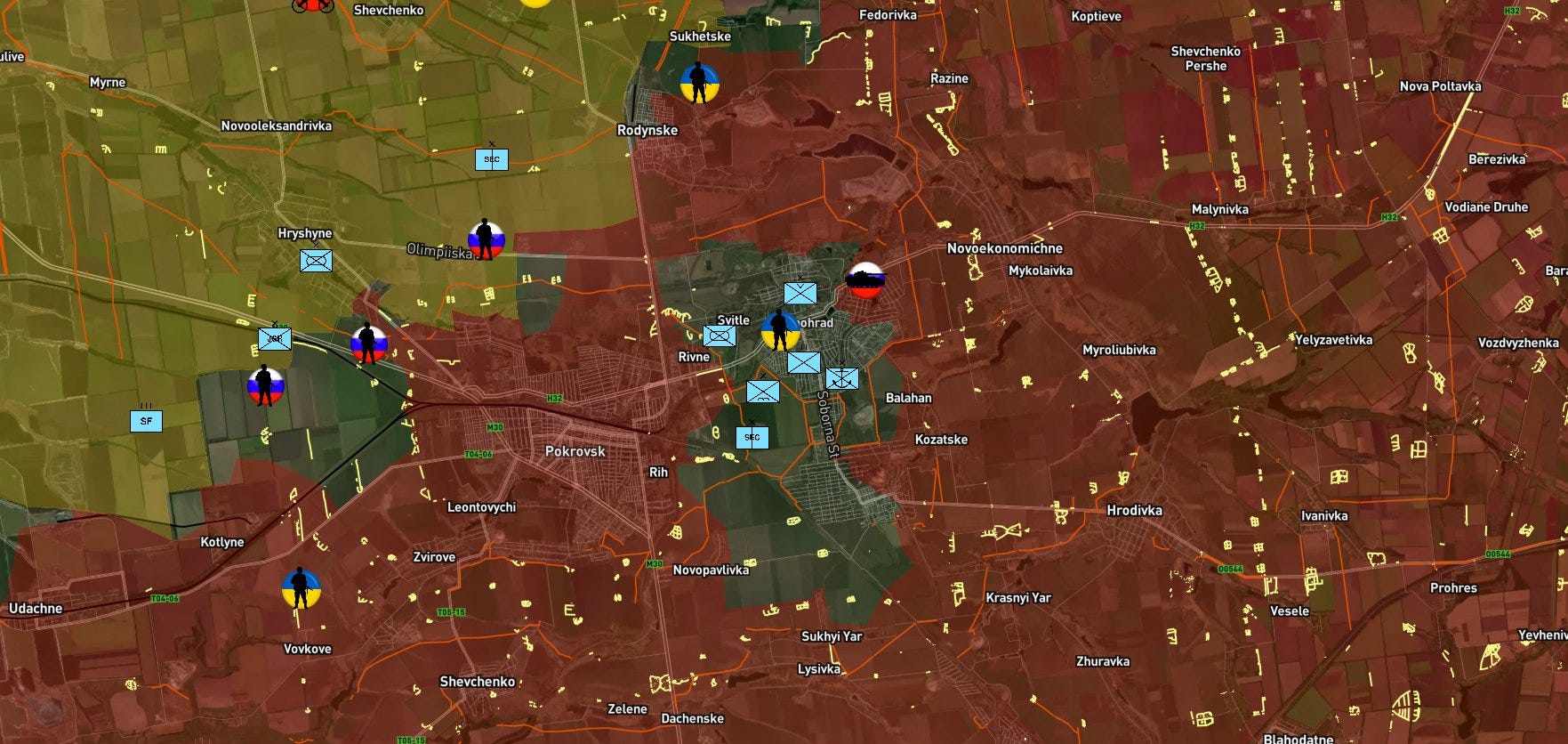
The Pokrovsk pocket (Myrnohrad) is closed. A fateful cauldron that we have discussed for years is at hand. Anywhere from 500 to 2000 Ukrainian soldiers are surrounded.
As things have thus far developed pretty much as we have discussed earlier, it is a good time for another strategic update.
Meanwhile, despite Ukrainian claims to the contrary, large parts of Pokrovsk is under Russian control and the pocket encircled (Military Summary map).
We have been discussing this potentially crucial event for years. We were likely the earliest in understanding the significance of the fall of Popasna, and likewise presciently foretold the impending fall of Bakhmut, Avdiivka, and Ocheretyne (the last one quite uniquely) and their consequence on the battlefield.
Prokrovsk is next on that list, and has been subject to our discussions from the outset, here in an early 2022 post as an example:

More recently , in a (quite prescient ) strategic update (link below) we analyzed its importance strategically, and postulated that due to the Ukrainian government’s lack of strategic wisdom, we would likely see its fall and aftermath, even while an early Trump administration made most experts think the war was at an end.

The above piece, posted back in Feb of 2025, ends with the following:
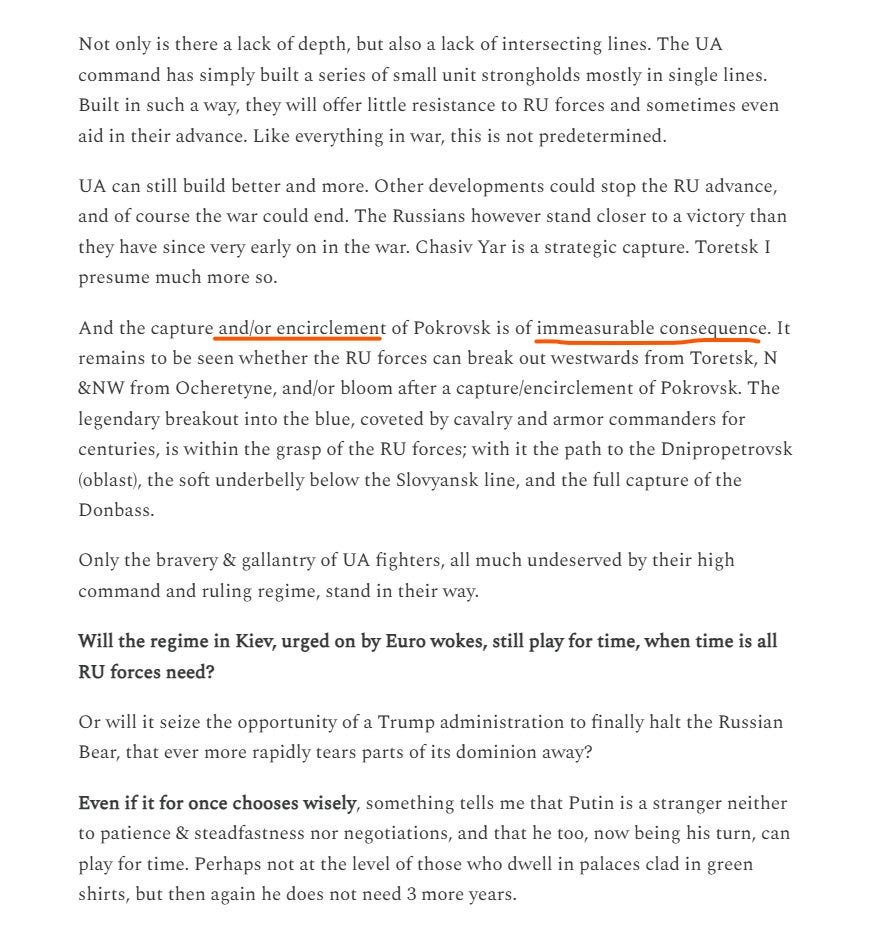
Indeed Kiev, urged on by Euro wokes, played for time when time was all Russian forces needed. Even today, though this is finally realized in some corners of the West (including within the Ukrainian government), it remains the Ukrainian overall strategy. We will analyze why this may be so in the upcoming strategic update.
For now, sufficed to note 3 key aspects of the situation on the ground around Pokrovsk.
Significant elements of the Ukrainian:
35th Marine Brigade
79th Air Assault Brigade
25th Airborne Brigade
68th Jaeger Brigade
are encircled and cut off from supply and evacuation lines within the Myrnohrad pocket. The total manpower within the pocket may range between 500 and 2000 men. Obviously, this figure figure changes daily as men surrender, are unfortunately killed, or are able to escape the pocket (mostly in small groups during the night).
The Russian forces level of control of Pokrovsk city is somewhat reminiscent of Toretsk, where Russian forces captured the city but thereafter kept suffering major incursions from UA forces for months. I believed that the well prepared Ukrainian fortifications in Toretsk may have included underground tunnels. These either allowed UA troops to hide for extended periods and/or connected them to UA lines.
It is possible that they simply were incursions that took advantage of the broad, low lying thickly wooded suburbs on its northern & western ends that the Russians had difficulty completely sealing (and that my recent experiences facing Hezbollah & hamas have made me susceptible to imagining tunnels abound!). The extent of the incursions in terms of depth and time, as well as the repeated nature of the locations increasingly indicated underground access lines.
We see early signs of something similar in Pokrovsk (which also shares the wide suburban edge allowing for many covered routes for incursion. The homes and the wooded spaces between, and the many small streets, make excellent territory for quality units to infiltrate behind enemy lines. Such territory also require a surprisingly large amount of forces to secure, hold and seal against an enemy compared to more open ground. A unit’s range of fire and visibility is heavily reduced and thus more are needed.
The encirclement is still thin. It is possible for UA forces to break out of the encirclement and for outside forces to lift their siege. Each passing day this is less likely as Russian forces tighten the noose and widen the thin western flank of the cauldron. But it is still possible.
As we previously discussed and predicted recently, cauldrons are now more likely once again largely due to the political and strategic situation the Zelensky regime finds itself in. In this type of modern warfare, slow moving, static lines, deep entrenchment and massive aerial surveillance, encircling large forces is extremely difficult; nearly impossible. Movement of forces is too easily and quickly detected by both sides, and the actual movements (during advance) very slow. One almost has to allow himself to be surrounded. Zelensky loves to order such actions, and as we discussed recently, despite the difficulty of actually closing a cauldron, I predicted we would start to see them again (not really seen since early in the war). Not only the mere threat of encirclement, which triggers a withdrawal (which happens a lot in this war), but actual closing of the pincers.
I also discussed how once they start happening, if significant number of forces are captured, the phenomena can snowball as Ukraine’s thinly manned front line would shrink to the point of collapse if whole brigades start to be taken out of the order of battle (after being surrounded and surrendering). So we shall see.
If the pincers hold, relatively hermetically, and there is no underground access to the pocket for the Ukrainians, we will inevitably see a large surrender event. It is possible that the Ukrainian high command and Zelensky believe that now the garrison can simply be supplied by air (drones) and hold out indefinitely. On the contrary, we are likely to see the garrison surrender quite quickly as soon as it is clear to it that the gates are shut tight. Supply by drone for such a large contingent is expensive (in the large drones you constantly lose), slow, inefficient, complex and insufficient.
Additionally, supply within the large pocket still requires further distribution by ground. It will become increasingly impossible. So either the garrison keeps collapsing on itself, making its position unattainable or continues to hold positions with units it cannot supply. To further aggravate this possibility, Russian forces are likely to continue to attempt to cut the pocket into smaller pieces. For these and other reasons, if the forces don’t break out or their siege lifted soon, and the Russian lines consolidate and widen westward, the garrison will shortly surrender.
That is if it doesn’t collapse even sooner. As it is, a strong motivating factor for not surrendering at the moment is that Ukrainian drone operators are as likely to attack UA soldiers walking towards Russian lines as Russian soldiers advancing towards UA ones. The very saturation of drones in the air and weak infantry control of the territory on the ground keeps everyone, including surrounded Ukrainian soldiers, in the basements. As this starts to change, the surrender becomes not only easier, but inevitable.
To Zelensky’s great frustration, the world will see the images, and he will have no one but himself to blame.