
Article version of the original April 9 2026 post:


Thus far the ceasefire has played out precisely as we expected.
“The announcement has the tint of negotiation with himself.”

We discussed as much in the piece above. In fact, there hardly was an agreement at all. In reality Trump self-imposed a 2 week truce, accepting as a negotiations starting point, a 10-point Iranian plan that had already been previously sent.
Afterwards, it seems that the administration is using the fact that there were some differences in the Persian and English versions (regarding uranium enrichment), as well as a post ceasefire version sent to the media by Iran, to imply that there is a much better secret version (that they won’t publish) that Iran sent privately. This effort aims to simultaneously discard the Iranian 10-point plan from the public discourse (supporters can simply chalk it up to disinformation and imagine the private one is much better), and use it as the basis to why the ceasefire was declared in the first place (imply it is a sign of Iranian desire for a ceasefire if not outright capitulation).
Again, as we discussed, the obvious Trump desperation for a ceasefire aside, what matters most is the intent. Allowing for additional troop arrivals and deployments, magazine and supply reloading, troop rest, and resumption of the flow of oil, LNG & commerce etc, before an operation to force the straight open, means ironically it is the Iranians who would be foolish to accept the short ceasefire and provide their enemy the breathing room he requires.
I previously wrote that the Iranians may have committed a strategic blunder in closing the Strait (forcing Trump’s hand in requiring an outright victory), and they would be reinforcing the blunder by agreeing to a ceasefire meant for their foe to reposition for a knockout blow.
Further I wrote “I think we will see at least mixed messaging and actions as far as Iran “immediately” opening the Strait of Hormuz. Not sure the entire command structure in Iran is onboard with this at the moment.”
We have seen this quickly come to pass quite precisely. Without tediously recalling every action and statement in the last couple of days, the bottom line at the moment is that Iran continues to exert control of the Strait, and requires ships to pass through its territorial waters, and request permission (and often pay fees), before they can transit.
This was basically the status quo before the ceasefire. Thus far, carriers have not taken Iran up on this opportunity and crossings remain very limited, still mostly of ships coming to and from Iranian ports.
Traffic had been increasing somewhat, as we had earlier predicted, with and without Iranian permission but the new uncertainty seems to have slowed the flow once again.
The Iranians, or some parts of the regime at least, are making claims that the ceasefire has been violated by the US and Israel, specifically with Israel continuing its fight against Hezbollah in Lebanon.
Let us be clear about this, as the media reporting has been terribly misleading.
First, to be frank the ceasefire technically is a non started to begin with.
Trump’s statement was that “Subject to the Islamic Republic of Iran agreeing to the COMPLETE, IMMEDIATE, and SAFE OPENING of the Strait of Hormuz, I agree to suspend the bombing and attack of Iran for a period of two weeks.”
Not only has the complete, immediate, and safe opening of the Strait not occurred, but even Iran’s response, penned by Iran’s Foreign Minister Seyed Araghch was in contradiction.
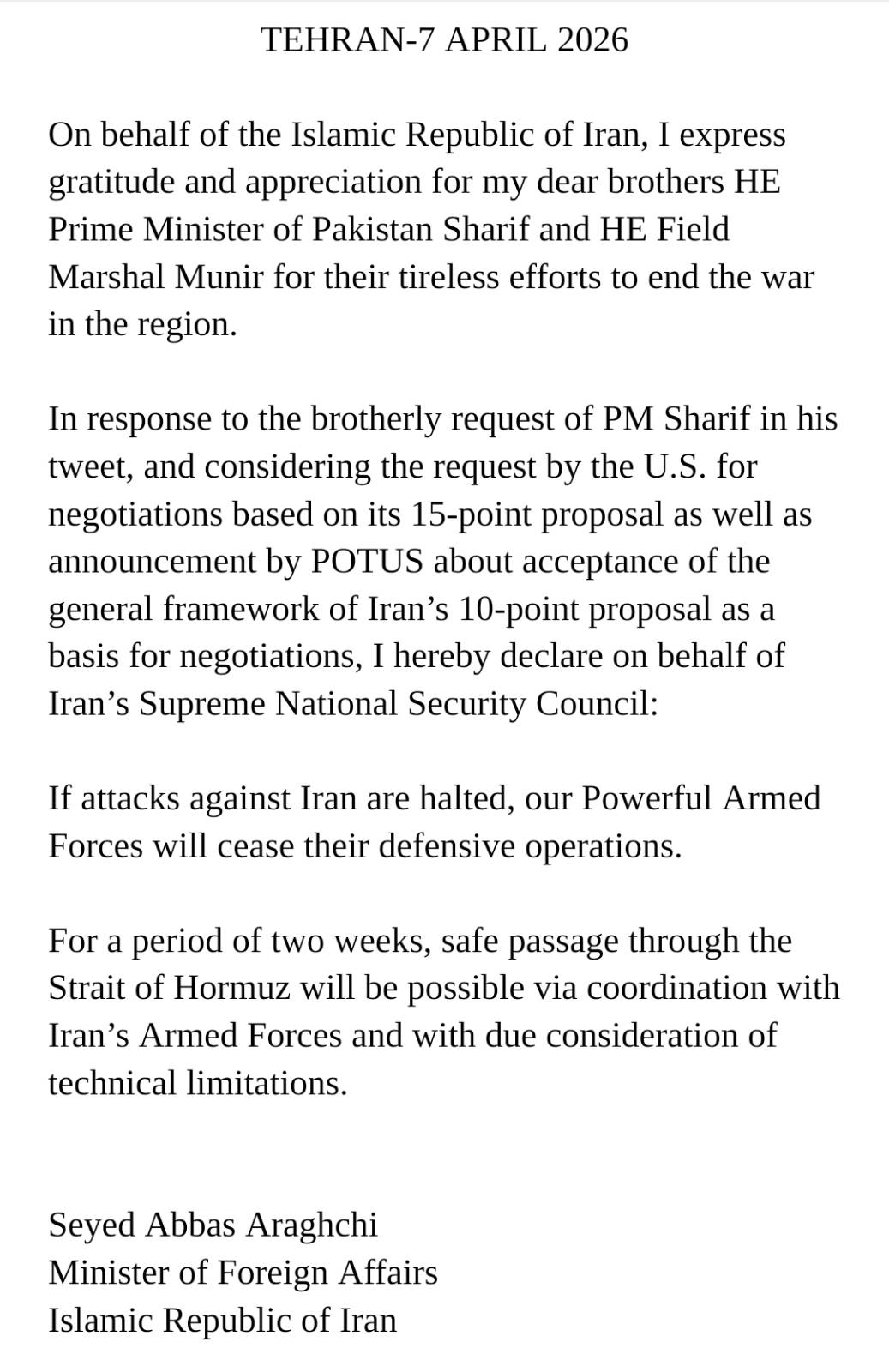
Though it accepts the 2-week ceasefire, and acknowledges that there is an Iranian 10 point plan, and a US 15 point plan, that will be the basis for further negotiations, at its conclusion it states:
“For a period of two weeks, safe passage through the Strait of Hormuz will be possible via the coordination with Iran’s Armed Forces and with due to consideration of technical limitations”.
Having to coordinate passage with the Iranian army is already at odds with a “complete, immediate, and safe” opening of the strait, but more worrying is “technical limitations” which leaves Iran able to limit volume of traffic.
With this in mind, the Iranian complaints about US/Israeli violations of the ceasefire are illogical, and I explain this further here (click on post for full text):

The truth is that both sides are thus far accepting the pause in fighting, de facto, but the ceasefire does not exist de jure. Because both sides want the pause, I think it has a good chance to continue if not the full two weeks, for a fair amount of days despite any violations.
The proof is clearly evident from the US perspective, who has continued to abide by the ceasefire despite Iranian closure of the Strait (which will become politically more difficult each passing day). Because the US badly wants this 2 week pause (if not a complete exit to the conflict), it is liable to continue to pressure Israel to curb or stop its fight against Hezbollah in Lebanon, even though this has been confirmed to never have been part of the ceasefire proposed, nor accepted.
Though Israel is likely to foolishly oblige, it shouldn’t as the US and Iran both want a pause anyways, and both are seemingly willing to overlook violations (or what they each claim are violations).
For example, though the original statement by the Iranian FM already laid the groundwork for non-compliance to US terms regarding opening the strait (”technical limitations”), Iran has already shifted to a more plausible reasoning.
Iran has warned that the normal shipping lanes (per the IMO Traffic Separation Scheme) in the Strait are mined, due the chaos of war of course, and despite the fact that they are mostly if not entirely in Omani and not Iranian waters. For their safety of course, ships should not traverse Omani waters but rather Iranian territorial waters in order to cross the strait.
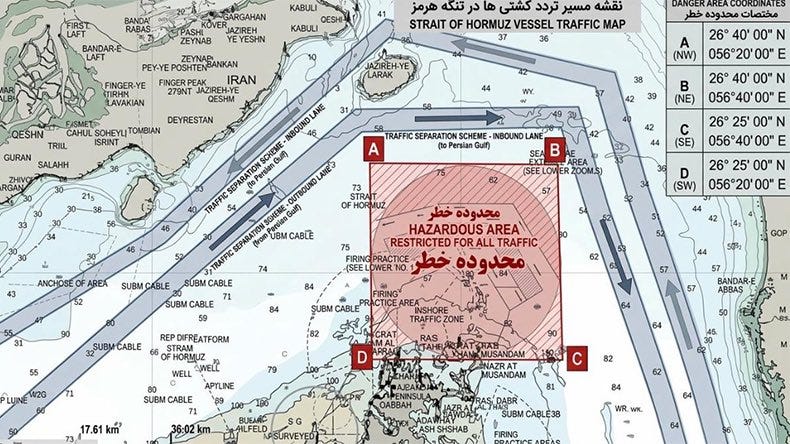
This excuse enabled the Iranians to go from actively threatening ships with destruction (clearly would violate the ceasefire and likely to restart US action) to passively threaten them with actions taken in the past (when presumably it mined the waters). The result is the same of course, the Strait is being controlled by Iran, but the plausible deniability is there.
Of course, the mines are most likely non-existent. The US wasn’t ready for many things in this conflict, but the potential mining the strait was not one of those. It closely monitored any such attempt and very aggressively went after Iranian mining capabilities.
Though Iran may try to use the ceasefire to mine the strait now and make its ruse real, for the moment I imagine everyone knows the danger zone is made up; in terms of mines that is. What it really clearly communicates to civilian shipping is that they are liable to get attacked and destroyed by Iran, if they attempt to traverse those waters without their approval.
And so what you have are two boxers looking for a breather, both willing to ignore the bell calling for the next round. Both can’t afford to let their public see them as weak or scared, and so the ceasefire is likely to partially and broken go on for a while, if not the full term.
Iran and the Gulf states have continued attacks on each other on a daily basis despite the ceasefire. The Gulf states were not party to the ceasefire, but Iran obviously was. Iran is insisting on adding Lebanon to the ceasefire, despite the original agreement, and as discussed, has thus far refused to open the Strait.
As far as the long term negotiations go, the positions are so far apart that a deal is most likely impossible in the two week period. The most that could be achieved on that front is additional extensions of the ceasefire.
But as we have discussed, unless Trump is now really much weaker than most give him credit for, the ceasefire is meant only to buy the time needed for the knockout blow.
I hope to have the time to do a deeper dive into what happened later, but in short we have a fairly simple set of facts.
How did we get here?
The US and Israel had a shorter campaign in site that would topple the regime. The original plan may have included the Kurds, special operations and giving air support to armed “protestors”. For some reason the plan did not work (meaning didn’t even start) or Trump decided to deviate from it (more likely). For example, after having been convinced to arm the Kurds and support their invasion of Iran, Turkey’s Erdogan and Iranian opposition parties (including the Crown Prince Reza Pahlavi) may have convinced him that backing them will lead to the partition of Iran, the hardening & unification of Persian resistance in support for the regime, and/or regional instability. In fact, we discussed these “dangers” regarding the Kurds at the outset of the war. I wondered if the US administration was unaware of them.
Once that original plan went out the window, Trump was still left with simply stopping the strikes and declaring mission accomplished. But as we discussed at the time, Iran closing the Strait changed everything. The war went long enough that now it could not be stopped without a clear winner and loser being discernable (a phenomena I discussed during Israel’s first 12 day round as well). A successful strike is one thing, a war another. And a superpower pleading with a supposedly defeated enemy to open the Strait is yet another still.
Thus, the Strait had to be opened by force, in order for the US to win decisively. Additionally, such an operation, if successful, is likely to lead to the end of the regime as well (due not only to economic and loss of prestige reasons, but also because of contact between Iranian populations in the areas seized and US forces - the opposition under air cover can spread from there).
The forces to do this were not in place. And they would take weeks to assemble. Trump kept up the air war as is for as long as possible, and when at end of his tether, politically, logistically and economically, he reached for this ceasefire.
For just a brief look into what some of these parameters includer, consider that VLS canisters require friendly ports to reload (Duqm, Oman and Diego Garcia at the closest). Original Tomahawks and interceptors aboard the warships are depleted. The US Navy still has not mastered VLS reloading in open waters, especially under potential fire (though its coming soon). Forces need rest and time to regroup. Bases within Iranian missile and drone range require repairs, hardening and additional bunkers. Units, ships and systems require maintenance and resupply. A pause in the tempo is required for calm planning the next offensive. Trapped carriers and oil tankers need to get out of the Gulf to keep barrel prices at bay. And of course, new units, both by sea and airlift need to arrive; they require not only the time to do so, but also airstrips and bases not under constant drone & missile fire. Supply stocks need to arrive and need to be distributed and stored securely. So much of what had been previously planned and prepared, at the 5th Fleet HQ in Bahrain was of no use, and needed to be relocated to outside the Gulf.
When it comes to units, about a week was still needed for the 11th MEU (onboard the USS Boxer (LHD-4), USS Portland (LPD-7) and the USS Comstock (LSD-45), and the USS George W. Bush carrier group to arrive in the area. The USS Ford CG was rejoining after repairs in Split Croatia as well. Additional forces and supplies may arrive airborne to regional air bases.
Thus, Trump needing the pause typically set up the ceasefire to look like an Iranian capitulation (and hoped to get one if possible). Once he already had received the 10 point plan in reply to his 15 point plan, he upped his rhetoric and threats.
He declared the civilization-ending ultimatum knowing that he would not need to follow through. He would make it seem like his threats worked and Iran broke. In fact, he know that at worse case (which is what happened), he could already refer to the 10 point plan as a workable basis from which to start negotiations and self impose a ceasefire.
The catch was that of course the ceasefire needed an open Strait at the minimum. Firstly for political reasons but also because it was likely one of the most important reasons for needing the ceasefire to begin with. Not only did the armed forces need rest, refreshment, resupply (and the arrival of the newly deployed forces), but the markets needed cheaper oil. Two weeks of free passage across the Strait, combined with the increased production elsewhere that has stepped up to fill the gap in the meanwhile (and enjoy the high prices), would be more than enough to weather any additional disruption the newly started and hopefully final campaign would cause.
Once the Strait was under US control, Trump could reverse the equation, Iranian ships could not transit while everyone else’s could. The regime could not survive the blow and the subsequent economic siege. US troops could leave the occupied parts of the Strait as soon as a new interim government was in place. The UAE could occupy the islands it claimed anyways and replace US troops.
In any event, once the Strait is open even for a bit... the European/NATO led efforts would patrol to keep it open. Once an international force is deployed, it inherits the fight if it comes under attack.
So that is what we have... the US needed more time to put in place forces to do a job it did not originally foresee it would have to do. If Trump has the strength to see this through, he can still bring about a great victory. If not, as I stated often, Iran brings home the prize.
One interesting sign is that we see the UAE escalating against Iran. It is seems to be trying to derail the ceasefire, either with or without US coordination. The UAE, as the most right wing of the Gulf states is the fiercest enemy of the far left Iranian regime, and it undoubtedly wants a clear victory over the regime. It also desperately needs the Strait opened. Not having taken the chance to join the fight with the US and Israel, it may find it more politically acceptable to start it now without them, as an Arab effort (perhaps to be joined by other Gulf states).
If the UAE knew that the ceasefire was a short term ruse, perhaps it would not see the need to take such actions. Alternatively, one could suspect it is the tool, perhaps along with Israel, to bring about the collapse of the ceasefire, in coordination with the US. Less likely but who knows. Disgust and desperation at the ceasefire and Iranian control of the Strait seem more likely the catalyst.
Another worrying sign is that if the ceasefire is not a ruse for time, but signals actual desperation for an offramp by the Trump administration, then the only path I can see they are considering is the following:
We get a ceasefire of any kind going, for negotiations and get the Strait open. Oil prices calm down and all is well.
The UK’s Starmer and his 30-odd countries, and/or NATO take the lead and start patrolling the now open Strait.
At that point, not a US problem anymore, at least not a lone US problem. If the Iranians try to close the strait again, they will inevitably clash with the large coalition keeping it open.
While this is a reasonable strategy if taken AFTER a US victory in forcing the Strait open, it is a terrible strategy if hoping to implement it after the Strait is open due to a US defeat. And not least of which, is because in defeat the Strait is not opened but left in Iranian control... as we are seeing now, despite promises and ceasefires. At that point the world may or may not wrest control of it back, diplomatically or otherwise, but the loser stays the loser either way. I’d like to believe Trump is indeed playing for time rather than simply desperate to get out.
Finally, the ceasefire, for as long as it lasts, brings about some new factors previously hidden by the fighting.
Firstly, Iranian leaders and commanders, previously terrified to meet, go out in public, and use communications will do all of these while under the protection of the ceasefire. They will go back to their cell phones and radios. This will be an intelligence bonanza for the US and Israel, and will allow for increasing infighting within the regime.
Secondly, the economic impacts of the war will be increasingly felt. The already tittering economy will succumb into even higher inflation as the regime comes to grips with the devastation it faces. It will have a very difficult time with state salaries, let alone with attempts at reconstruction and re-armament. The air campaign’s devastation, and its consequences, will gradually come to bear.
The regime’s single salvaging factor is the Strait of Hormuz. Both as its restriction has set oil prices soaring, as well as in the fees Iran has and wishes to continue to take. Even 20% of previous volume paying about $2 million per ship would be a massive bonanza for the stricken regime. But if the ceasefire requires its unrestrained flow, or the US otherwise forces its unrestricted opening, then oil prices come down and there are no “toll” fees for Iran. That is without even speaking of the US actually blocking its (Iranian) oil exports. That, the regime could not survive, especially when its demise means not only the export of oil once again but the removal of the harsh sanctions, along with billions for reconstruction.
This leaves us with a possible third scenario. Even if the US means to negotiate to end the conflict, and the additional forces are at most meant to partially re-open the Strait, not by occupying any Iranian territory but simply by increasing pressure on its forces trying to exert control of the strait, with the hope that NATO and an international coalition began patrolling, mine clearing and escort duties within the Strait; the regime may increasingly start to collapse (ironically reverting the situation back to the original plan), and put the US within reach of a victorious outcome despite its previous decision to be humiliated and defeated. This is not an impossible outcome and it would look something like this:
Talks lead nowhere. Ceasefire extensions at most.
Iran continues to restrict traffic across the Strait of Hormuz.
Ceasefire holds anyways. At least in terms of the US holding its fire.
Iran gradually eases restrictions on the Strait, in return for sanction relief, unfreezing of assets, reconstruction funds.
At some point, after or during any of the above, it becomes clear that the regime is collapsing in the face of dire economic straits, inflation and failing utilities (water, electricity, fuel, internet), either due to regime in-fighting, increasingly active insurgency and/or mass protests. The US switches positions and backs anti-regime forces, providing support, logistics and air cover.
Keep in mind that in the absence of number 5 in the near future, the not unlikely scenario spells a strategic US defeat. But as always I remind, wars are battles of wills, and here we are to see if the West still has even the small amount of will, honor and self respect required, to defeat a determined but vastly inferior foe, who has shown, even if it is largely due to existential lack of choice, the will to fight, resist, and not easily give up.