
Article version of original post March 15th 2026:


As we have been discussing, the ultimate scoreboard on the war will relate to passage in and out of the Persian Gulf. If the US is able to largely resume traffic without a deal with the current regime - so either dealing with a new regime, accepting what amounts to a surrender from the current one, or forcing the straits open to shipping in spite of Iran's desire to close it - all amount to a US victory. Iran has no other cards left.

Anything else, namely a US end of the conflict in return for opening the strait (or worse a US end of the conflict without an Iranian commitment to cease attacks on commercial shipping, but only a hope of it) with the regime still in control is rightly considered an Iranian victory in the conflict.
Note that this potential Iranian victory would not necessarily detract from the fact its missile and nuclear programs lie in tatters (only would reinforce that this should have been the only goal of the conflict as I advised from prior to even the June hostilities), and that the regime itself could be toppled a bit down the line due to economic conditions and the massive damage it sustained. Even so, the appearance of having resisted and bested the world's superpower would help it endure, contrary to the perception created in the 12-Day war with Israel alone (one of weakness and exposure of the Iranian Paper Tiger). This is why the former round, as I predicted then, led to widespread protests against the regime after war (but not before).
In any event, I am a bit surprised at the US' lack of preparation in keeping the strait open. While Israel has focused on northwest and north-central Iran, its economic, administrative and population core (including Tehran), the US's turf was the southern coast and the Strait of Hormuz.
CENTCOM commander for the last 7 months or so is Admiral Brad Cooper. It is very rare to find the CENTCOM commandeer having come from the Navy.
This shows how important maritime issues and the Gulf including the Strait were in the administration's thinking. It also probably explains why there was such a focus by US forces on the Iranian Navy in the opening days of the war.
One is enticed to think that Cooper, was overly focused on old fashioned Navy thinking. The Iranian Navy was hardly more of a threat sunk then floating. Their ability to physically close the strait, as I discussed in the past, in the face of US forces was near zero. The obvious threat comes from drones (air and sea), anti-ship missiles and mines. That is with mines the least important threat as they come under traditional navy and maritime threats well understood by Naval forces for many decades.
The US seemed to focus on Iran's traditional Navy and mining capabilities. Mines played a very important role in the Tanker War of the 80s.
One can only conclude that the administration was really convinced (specifically contrary to my published advise) that the regime would fall quickly and easily while under attack. It did seem to have thought about insurance and war risk premiums, which is what froze up the flow of traffic through the strait originally, but do not seem to have a plan in place to eliminate near 100% of the anti-ship and drone threat in the gulf which is what is needed to keep traffic flowing at normal rates. Especially for Western companies under massive liabilities for ecological damage and the lives of their crew, far beyond what any standard policy would cover.
In any event, whatever administration officials thought previously, they are certainly trying to focus on this issue now.
We have seen much reporting about Kharg Island. The US recently struck 90 military sites on it, on the news of a Marine MEU (31st MEU) aboard the USS Tripoli being on their way (~1 week away or less by now).
Kharg Island - A Diversion?
As we already discussed, destroying Kharg Island's infrastructure is quite unnecessary. Seizing it is a good symbolic achievement (perhaps liable to be leveraged due to Amoco’s old rights, violated when the regime nationalized them) and perhaps allows you to "tax" Iran's oil exports, but would obviously increasingly incentivize them to export through Jask Port & elsewhere beyond the Strait. Really, since the US controls the water east of the Strait and around the Gulf of Oman, Iran already can only export with US acquiescence. The US is apparently letting Iranian oil flow because it helps keep oil prices down while the other Persian Gulf exporters are bottled up.
As that changes, the situation may reverse (allied oil will flow, Iranian stopped). It seems to me the US is committing a short sighted mistake in this regard. Iranian oil exports should be stopped while Iran continues to block the Strait. At the very least, the tankers should be taxed, where for example 50% of the oil is taken by the US to allow the other half to proceed.
If Iran is desperate enough, and depending on what the tax threshold is, it may continue to export in this manner, which would then not contribute to diminishing oil in the world market (both halves end up available to customers). But simply leaving Iranian exports to sail freely while they block the strait is odd to say the least. It indicates desperation in regards to the world barrel price.
In short, taking Kharg Island would block these Iranian exports (it would be awkward to attempt that they continue), which the US is allowing anyway as we speak. Makes little sense.
It is also strange to "telegraph" such an amphibious invasion so far in advance.
Previously discussed earlier in the war why those (such as Yair Lapid) arguing for the destruction of oil infrastructure on Kharg Island were missing the point.
The Iran war (R-2) continues, long with my accurate Prediction Winning Streak

Happily, my readers are no strangers to seeing make some accurate predictions. But the last few days has been a real quality streak. Here is a recap, and where we may go from here.
With this in mind, we might be looking at different targets for the MEU and other US forces, while Kharg Island may turn out to be a diversion in the media to fool Iran.
I will follow up later on with more details on these, but note that due to the shallow waters of the Gulf, large tankers need to sail between Greater Tunb Island and Abu Musa island.
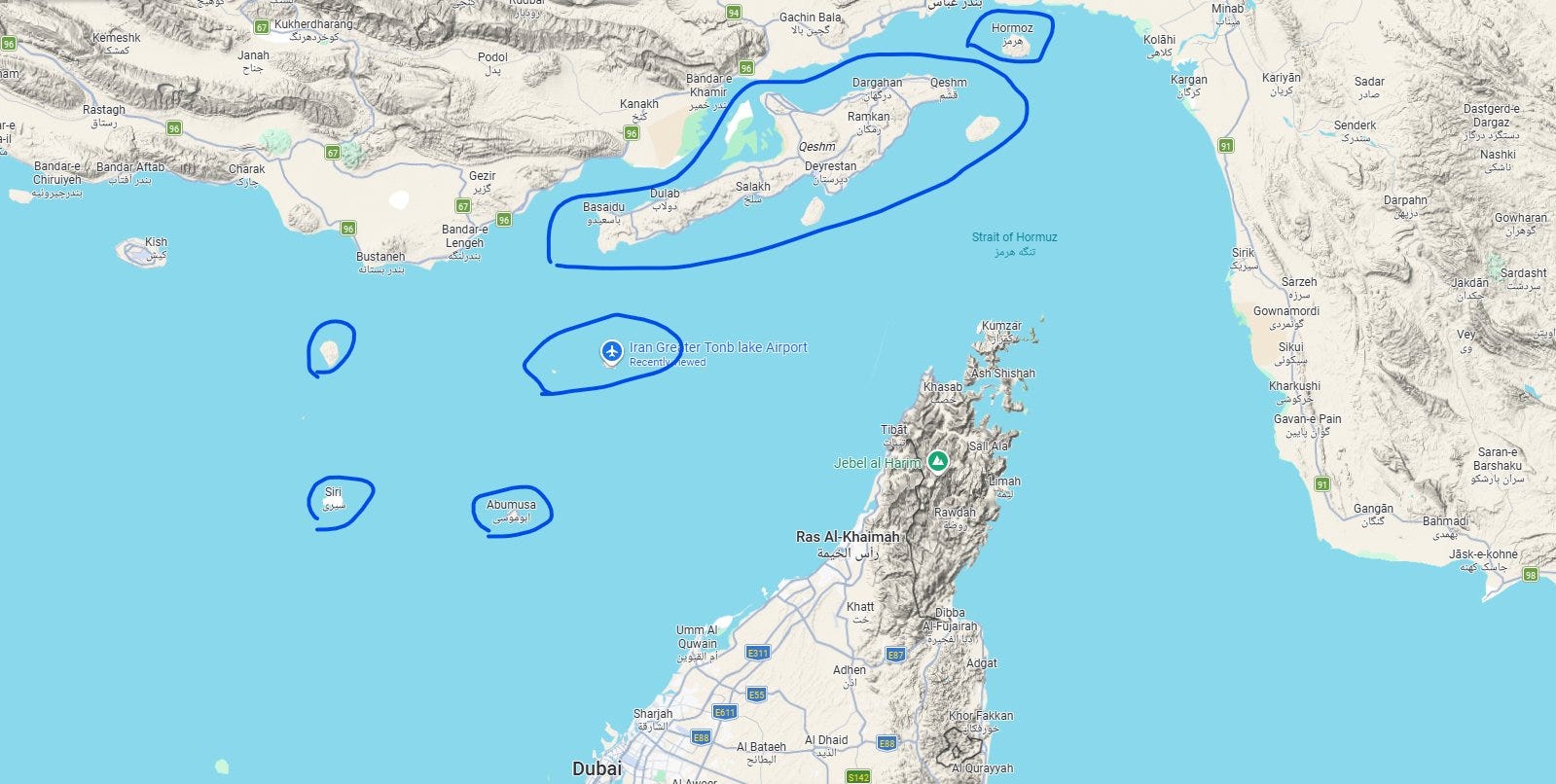
These islands conveniently disputed by the UAE, as Iran seized them in the 1971 (part of a somewhat complex story I can cover more in detail later).
Iran has refused to litigate the issue in international courts, and by closing the Strait, Iran gives the US an excellent pretext to seize them and it risks losing them to UAE or international sovereignty. There are excellent ecological reasons for non-Iranian sovereignty over them which western media can happily consume. From endemic coral carpets to sea turtle and migrating bird habitat, the Persian Gulf islands (especially Abu Musa) are ecologically very interesting.
More critical for the narrowest parts of the Strait when considering larger and populated landmasses, not the small islands, is Qeshm island (along with neighboring Hengam and Larak Islands). At its narrows, the strait is a little over 50 kms between the Iranian mainland and Oman, and only a bit less between the Omani coast and Qeshm Island. However due do the depth of gulf and visibility differences,
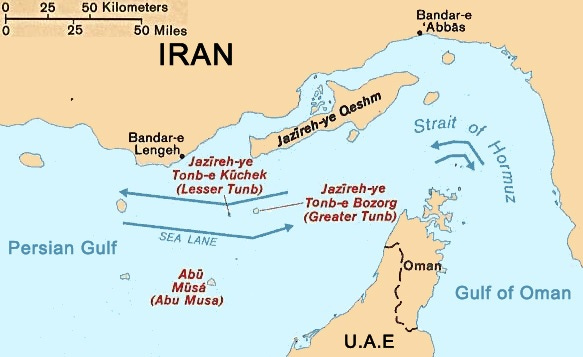
we see that Qeshm island, and other Strait islands are of supreme importance in controlling the Strait. Only 100 feet height above sea level typically gives an observer a 12 mile visibility arc towards the horizon. Ships have to sail very close to that visibility window when it comes to Qeshm island.
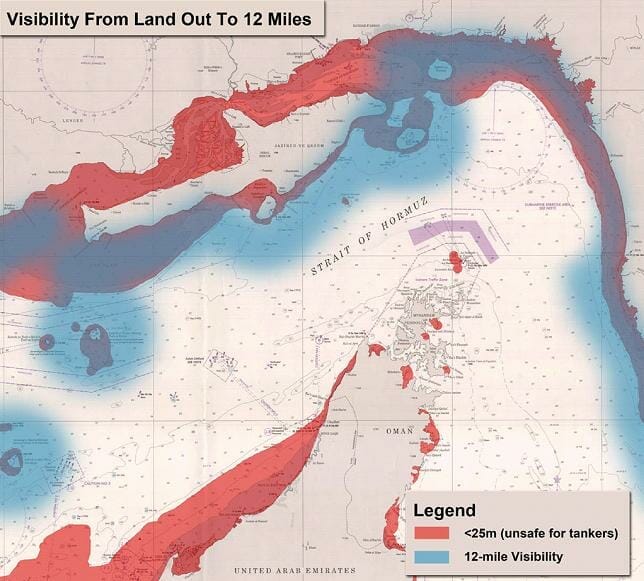
Additionally, Qeshm is in the way of the high mountainous areas in the Iranian mainland which threaten the Straits.
While Arleigh Burke Destroyers are ideal for integrated Air Defense and can help keep the Straits open in the short term, as a long term solution you want land-based systems.
These drop dramatically in efficiency if they are "behind" what you intend to guard. It is very difficult to protect shipping in the Straits with AD systems in the mainland south (or west) of the ships they wish to protect. Especially against smaller caliber and low flying (or seaborne) munitions and drones.
Having land based systems north and northwest of the ships is ideal.
The US has about 80 Burke Destroyers, and in a pinch can send 3 to 6 more to the region without causing too much disruption to its other commitments (including repair & maintenance etc). These can help create a AD box in the Straits, but a longer term solution will depend on land based systems to a greater extent.
This is not to speak of the entire length of the Gulf. We should keep in mind that Iran's ability to strike along the entire gulf diminish with the greater width, shipping lane proximity to Gulf state defenses and Navies (pretty absent thus far), and with time as it continues to get degraded by US and Israeli offensives.
As its ability to observe ships diminishes (radars, forward observers etc), it will be very hard for Iranian forces to hit ships moving at speed in the Gulf, even with drones. Once you get closer to Basra, and the Iranian borders gets very close again, it once again becomes easier.
Note that almost all recent strikes have been against stationary ships.
Sailing at night is likely to become very important. Not only is it more difficult to observe targets (commercials hipping) and its escorts, but more importantly it is easier for US and allied forces to find the source of fire. Launching and firing light up the night sky.
This is why Iran has mostly stopped firing ballistic missiles at Israel during the night, and switched to daytime launches. Too many mobile launchers and their forces were being hit before they could escape, and there are fewer and fewer willing Iranian forces daring to fire each day.
The most important defense will continue to be offense. Whenever Iranian forces fire, the allied forces must be ready to strike at them fast. The willingness to engage commercial shipping will then likewise diminish.
Despite all this, escorts for the length of the gulf will be very important in any prolonged conflict. This is where ethe US is likely to want international cooperation. Escorts and Destroyers can escort convoys for close protection. However, if this fails to materialize, the US is still capable of providing the additional escort Destroyers if it must. Though this is certainly a sign that the US Navy is currently much smaller than it ought to be, as after al this is a relatively small conflict against a weak adversary. Should China chose for example, the opportunity to invade Taiwan, the US would find itself in an uncomfortable position.
Dealing with regulations & insurance will also be important. Mainstream carriers with millions and billions in equity cannot chance the crossing with western rules in place. The 100 million in equipment insurance for the ship is nothing compared to the liability. Liability in case of harm to the crew and even greater liability in case of environmental harm. This is why "Shadow Fleet" ships are already crossing the strait and will continue to in growing numbers.
Western regulations also often greatly limit ship self defense. There are plenty of private companies that will offer a high level of protection for the ships, but depending on the carrier's flag, these may or may not be allowed. The administration would be wise to pay attention to these issues and encourage brave crews to be able to challenge Iran in the Gulf as much is possible. The higher premiums are there to reward the courage. Western rules often negate and prohibit courageous action.
In a later piece we will analyze the islands, and the topography with more detail, but the interesting factor at play is that we may be seeing Iran again miscalculate and inviting an amphibious invasion of one or more of its strategic islands that ensure control over the Strait of Hormuz. In different terms, by throwing down the gauntlet and proving that the Strait is closed in defiance of the US and Trump, they have encouraged the President to proceed until a complete victory, whereas previously he was amenable to stop the strikes quickly. Stopping now would be correctly interpreted as an Iranian victory, due to the US’ impotence in reopening the strait.
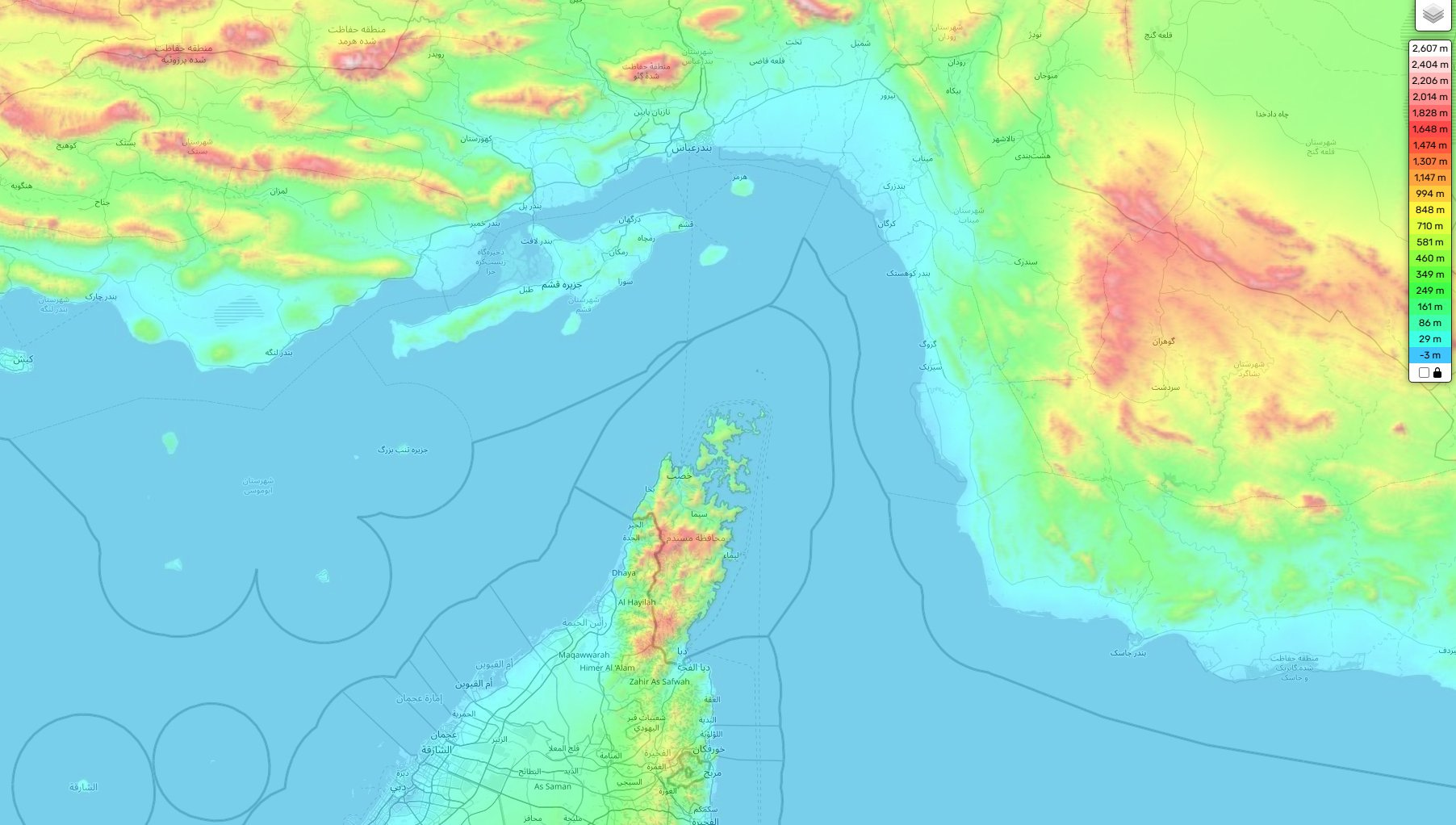
To recap, Kharg Island, if the US is cunning, might be a side show. It would add nothing as far as control over the Strait, nearly nothing as far as control over the length of the Gulf, and likewise nothing over control of Iranian exports which as it is must traverse US controlled waters east of the Strait.
Importantly, the US should announce loudly and clearly, that weapon shipments, especially anti-ship weapons, will be intercepted in the Caspian and elsewhere regardless of the carrier. You want to avoid a situation where Russian carriers are bringing anti-ship missiles to Iran and attacking them is an escalation. The mere announcement of the policy puts Russia in the position of escalating, which it does not want.
Iran's ability to continue its threat over commercial shipping requires ongoing advanced munitions and drones. Its domestic ability to produce these is already destroyed and will continue to be as long as the US and Israel maintain the air campaign over it. This means that it would require import of such weapons, that given the US control of the waters we discussed above, is only possible through northern land routes and the Caspian Sea, with its direct access to Russian Caspian ports.
The 31st Marine Expeditionary Unit
A Marine MEU is a small (about 2,000 men) amphibious unit that can definitely take the kind of small islands we are talking about. An MEU includes a Ground Combat Element, reinforced battalion size, an Aviation Combat Element, and a Logistics Combat Element (also battalion size). They typically form an ARG (amphibious ready group) in 3 amphibious ships (other escort them forming a larger ESG) including a LHD/LHA (in this case the LHA on its way is the USS Tripoli), an LPD and a LSD - reminds of the Falklands war. Wonder what Commodore Michael Clapp and his adventurer Yachtsman Lt. Col Ewen Southby-Tailyour are saying. Probably that they don’t know what they are getting into… but the Gulf in March is not the South Atlantic in winter. And unlike in the Falklands, no air force opposes them.
We don’t know if the entire ARG is accompanying the USS Tripoli. My guess is that it is (otherwise you have a very weak amphibious unit) and probably being accompanies by a couple of Littoral Combat Ships that were also in SE Asia which can serve as escorts and demining platforms. Opposed amphibious operations are the most complex military operations and require a professional and well equipped force to carry out successfully. It will be very interesting to see a modern MEU take on this task, even if in a small island. The Ground Combat Element of the MEU includes specialist forces like the combat engineer platoon, reconnaissance platoon, an artillery battery, an others which would be crucial in setting up defensive systems on the island.
You likely want to take an island with an airstrip and a basic dock already existing, so that a garrison can be logistically sustained after the MEU moves on. Abu Mussa, Greater Tunb, Siri and the large Qeshm islands all have basic airstrips. The smaller islands would be an easy capture, though Qeshm is another story, much larger (1,500 sq kms) and populated (149,000 people) across from the major Naval installations of Bandar Abbas. Then again, the entire Hormozgan province has a wide mix of ethnic minorities (who came in search for work) and relatively a protestor stronghold, so who knows.
The Market Predicts Lower Oil Prices
Finally, let us briefly address oil prices.
Reporting, rather incorrectly is focused on the current spot price.
There is nothing to be said that about the fact that dozens if not hundreds of tankers had their routes disrupted at the outbreak of the war.
Ships are slow, and so naturally oil that was expected in many places in the world did not or will not arrive as was expected. This forces these customers to scramble to buy it elsewhere and biding competition raises prices. That is.. if you want oil Right Now you have to pay more for it.
But the market seems to be betting on the US (together with world output flexibility) solving this issue. From greater US domestic production, to Saudi and UAE shifting export through pipelines that lead outside the Strait, and Persian Gulf flow resuming to some degree, they see ample possibilities for solutions.
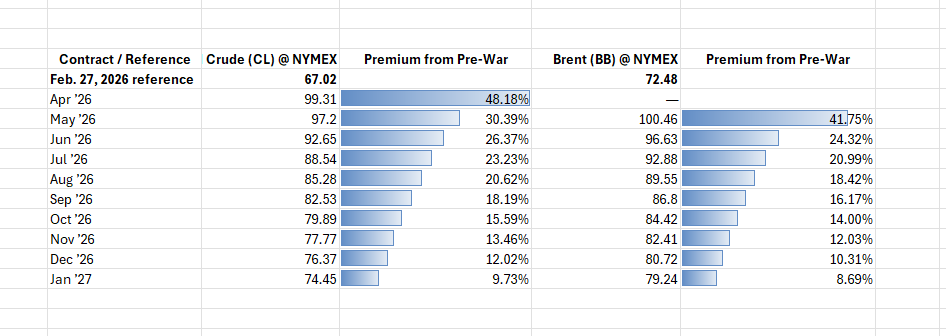
The oil futures, both West Texas Intermediate in the US and Brent Crude in Europe see a pretty dramatic drop in prices in the next few months. We see that by the beginning of 2027 (and the Nov election), prices for both are nearly back to the historically low price pre-conflict on Feb 27 2026 (only 8.7 - 9.7% higher).
The drop from now until then is fairly linear and significant each month, especially in the next couple of months. So, the markets have plenty of confidence in the Trump administration's (or at least in the world oil industry's) ability to handle this situation. Hopefully the administration has the same confidence in itself and goes ahead and does so.
Once again, it would be another final nail in the coffin of the West if the Iranian regime's strong show of will, would overwhelm what tiny amount of will needed by the West, to defeat it.