
Recently there has been rampant speculation about an imminent US attack on Iran. This strike could involve Israel from the start, or quickly grow to involve it as Iran is likely to target the Jewish state in retaliation, with its ballistic missiles.
It would thus quickly evolve into “Round 2” of the Israel Iran war that didn’t quite finish. We discussed it at significant detail in various posts such as here:
Israel & Iran at War - What Next?

Earlier we discussed Operation Rising Lion. In fact, Iran’s ballistic salvos were drastically reduced as we discussed and predicted (though the launching being the bottleneck, their best missiles, of more limited number, were used and penetration percentages did increase).
Let me briefly (or knowing me, not so briefly) summarize some of the main points we have discussed:
Regime change is probably not a good military goal.
It is the Iranian’s business how they rule themselves. I care that they can’t nuke us. In any event, Iran is far more leftist and far more Shia than many people and governments understand. There are some who are not so leftist but very religious, and even more who are not so religious but very leftist. The overwhelming majority of the Iranian population is deeply leftist/socialist and at least nominally Shiite.
Ethnic differences are somewhat set aside or deemed less important (than in many other Muslim countries) as long as the groups are Shiite. Iran is the mother base of the Shia world. This is a big deal in a largely Sunni Muslim world. It is only where the minorities are Sunni, that ethnic differences easily translate into armed conflict, mainly in the case of the northwestern Kurds and the Southeaster Balochis.
Good example of this are the Azaris and Lurs. the Azaris (ie Azerbaijanis) form a large percent of the population and are clearly ethnically distinct, being a Turkish people with their own Turkic language. And yet tension with the Persian-dominated state is existent, but of low intensity. The Azaris are largely Twelver Shia Muslims, like the Iranian state and well integrated within it. Many political leaders are fully or partly Azari.
Likewise the Lurs, who many even identify ethnically as Kurds (or at least the Laks & others within them as such), also co-exist in relative peace with the regime. Whereas the (Sunni) Kurds are in virtually open warfare with the state as they are openly Sunni. It is the same with the Balochis. In Iran, the Shia / Sunni divide is more important than ethnicity, especially as intra Shia ethnic assimilation and intermarriage has increased over time.
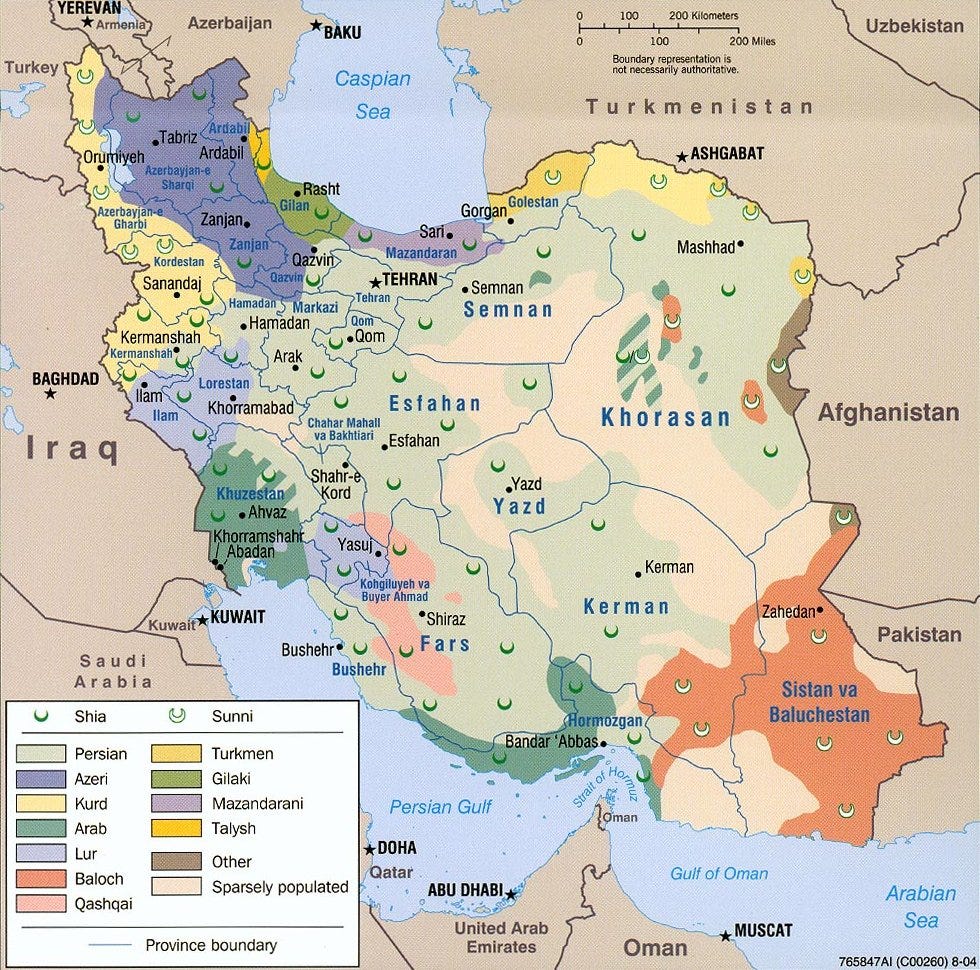
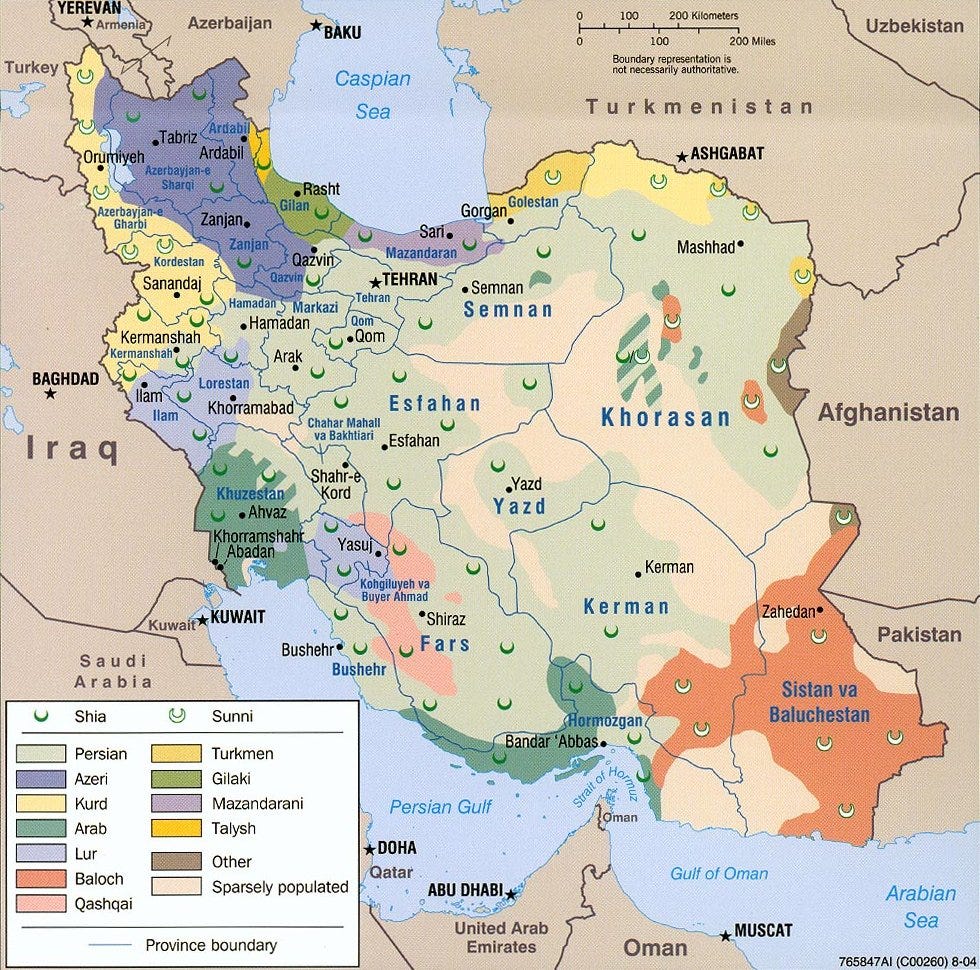
Iran is very largely Shiite. This Wikipedia map does a decent (though simplified) job of showing the ethnic plus religious geography.
As I like to say, it is hard sometimes to know if the Iranian Revolution were Shia Muslims dressed up as socialists or socialists dressed up as Shia Muslims. In the West, people are unaware of the Iranian leftism, but it is a driving factor of the “Revolution”. It is why the regime is friends first with leftists, regardless of religion rather than the other way around. Where you find socialists and communists, you will find Iran’s good graces, be it Venezuela, CCP China, Cuba, or Hamas-run Gaza. That Hamas is Sunni or Venezuela highly Catholic or the former Assad regime of Syria so secular is of no concern, they are socialists first. Their visceral hatred for Israel also comes from viewing it in socialist postmodern terms of an imperialist European colony rather than a state of the Jews (the way a Saudi Prince might see it). A conservative Muslim opens up the Koran and reads about the Jews… he may not be their friend, but he sees them as part of his world, and the neighborhood. A revolutionary communist foams at the mouth, enraged with vile and jealousy at the European colonial enterprise.
If one actually reads their constitution or hears their speeches, from Hamas to Hezbollah and the Ayatollahs themselves, the Revolutionary Shia axis is often more woke than most could imagine. It is one of the reasons conservatives are sometimes baffled by the far left’s support of certain supposedly fundamentalist Muslim regimes. We all hear the line of “Don’t these gays know that they would be killed there!”. The truth is that while ignorance is not lacking in these circles, these leftists an naturally sense the leftism in their counterparts, and it is actually often the befuddled conservative who is blind to this reality. This is why the gay parade will not often be seen marching in support ISIS, or the Saudi Kingdom… definitely not for the UAE. They have no sympathy for these conservative hardcore Muslims. But give them a Hamas, Hezbollah or Ayatollah any day… all they see is a Che Guevarra picture. I think you will find I am rather unique in trying to point this out in the West.
Iran is thus overwhelmingly Shite and leftist socialist (only a very socialist country, (think Venezuela, Iran) can pull off having that much oil and still be so poor). Some sectors of the population are more Shia and less socialist or vice versa, but they are overwhelmingly at least one and in the large majority both. Thus the regime is not their enemy. They may topple it eventually due to dire economic conditions or internal politics, but the regime and the people are much closer than folks in the West understand.
So regime change is not a goal I would chose. But if you do opt for it, know that you are picking a difficult task. As I wrote during the 12 day war, the people will not rise up in Iran while the Jews are bombing them. Yes… enemies of Iran, the Kurds, the Balochis, of course. At any opportune time. But not the bulk of the population. The regime can fall as I wrote, afterwards, be it weeks, months or longer, after a hard and successful strike (and because of it), but not during it. Not in the short term at least. The fact that widespread protests began months after the war is evidence to my typical prescience. Of course if you maintain a prolonged air campaign against the regime for moths, that is another story, and anything is possible (or if you literally take out enough leadership that whomever takes over can pass itself as “regime change”) . But I maintain that regime change during a hard short term strike is unlikely, as it unites the people.
Additionally, if regime change is is the goal nonetheless, there are two most important targets that I discussed before. Since it is economics that can actually topple the regime, then removing the last critical resource the regime control and relies on is key. Knock out the major fuel refineries (that largest alone produces 40% of Iran’s gasoline). I spoke at length about the interplay between economics and military operations when it comes to refineries in an article on the Ukrainian strikes on Russian refineries, in this piece:
and there also pointed out how the situation in this regard in Iran is much more different than in Russia. The subsidized fuel in Iran is critical and all that the state has left to provide (as it can’t even provide water).The second critical target would be the prisons. Especially those housing a large amount of political prisoners. You see, one thing is to be afraid of the consequences the regime can dish out, and opt to stay safe inside your home; and quite another to find yourself an escapee already. An escapee is desperate to never again return to the torture, squalor and even death that awaits him in an Iranian prison. Once freed, desperate to not return, he is an avowed do-or-die enemy of the regime. Thousands of such escapes, who to begin with are imprisoned for being the more politically active and outspoken, can form the nucleus of a much larger movement as they bring in their families, friends and clansmen to aid in their cause. Having been imprisoned together, they also will have widened and improved their networks.
Evin Prison reportedly was hit by Israel during the 12 day War. Cannot confirm if this is true or fake news, but if it was real, it was more of a symbolic strike and not executed with the level of precision and planning that accompanied other parts of the Rising Lion. Prisoners cannot escape simply because the front gate was blown up. Freeing them requires a more involved operation.
Lastly, if regime change is the goal, I would not target the old Ayatollah Ali Hosseini Khamenei. Like I said, the Iranians are in large part supporters, however discontent they are at the current dire economic situation, and lionizing the old leader serves no real purpose. My readers know I am not a fan of targeted killings as it is, and when they happen there has to be a very good reason for them. Letting the man be toppled, lose, abdicate, surrender, etc is much better. In order for taking him out to succeed in anything resembling a regime change in short order, the US or Israel would have to also take out many other figures, including most if not all of the members of the Guardian Council and Assembly of Experts (which elects the Supreme Leader), and perhaps sons of the top leadership.
Iran and Israel both learned lessons from the 12 day war. For Iran, it was namely that fixed site launchers are pretty worthless and easily taken out. Their bottleneck was mobile launchers. They need more mobile launchers and the forces capable of (and willing, under fire) fielding them in war. They also learned the value of solid fuel missiles rather than liquid fuel, which drastically cuts down on the time needed for launch (and the window for Israeli Air forces to take them out). They also learned that their masses of drone and lower quality missiles are useless against Israeli AD. Only their most advanced ballistic missiles could penetrate as we discussed. So a second round would l likely see Iran sending less but more advanced missiles, rather than the nightly hundreds that were fired in the early days of the war.
Israel for its part knows that Iran learnt this and will prepare accordingly. Specifically it needs much larger stockpiles of ammunitions for high altitude ballistic interceptors that can handle the advanced Iranian ballistic missiles. It means much more exo-atmospheric Arrow 3, and more Arrow 2, rather than only large volumes of David’s Sling and Iron Dome. Obviously, it needs to be ready to take out the mobile launchers faster and more efficiently. If regime change is the goal, more involved and intelligent operations are needed, especially getting proxies, agents and other forces ready on the ground. Or if they care to read my articles, operations to free prisoners (and strike the refineries). I would be content, if the operation goes on to the point where Iran cannot fire back anymore, the IAF flies freely over Iran and picks its targets at its leisure, and the Israeli airspace is open for business while the Iranian is closed. This is winning the Air War and is what I hope is aimed for (along with the original aim of crippling the nuclear program and advanced ballistic program). I like winning wars much more and killing people much less than most of my higher command.

So why has the strike been delayed?
I believe there are several key reasons, and they are interrelated.
Firstly, I believe Trump has come increasingly come to view Bibi Netanyahu not only as a wise and intelligent man, but also one Trump can trust and rely on. Israel has ben likely pushing for a delay for various reasoning including:
Let the winter pass. This is especially important if there are plans (for us ground forces) in the north, Lebanon and Syria. It is also better for Air operations.
Israel needs more time to stockpile the AD munitions (and other munitions) it requires to be ready for Iranian retaliatory strikes. It wants to be sure it has enough to maintain the war long term if need be.
Israel wants the US to have an intelligent and well planned operation ready to go. This involves work on the ground, that is meant to facilitate regime change.
The Saudis, for similar reasons, but mostly the latter one, are also pressing for a delayed but more decisive strike.
Trump for his part, I think has become receptive to this line of reasoning for one major reason.
The lessons from the operation to capture Venezuela’s Nicolas Maduro.
You see, Trump likes to shoot from the hip. He doesn’t necessarily plan or even think things through many steps ahead. He believes in his good instincts and that often, all you need to do is shake things up, rattle the cage as it were, and then seize a good opportunity or path as it arises, opens up or becomes clear.
However, the Maduro operation may have taught Trump something when it comes to complex geopolitical operations. While the part of the operation that was meticulously, and remarkably intelligently planned out was a total and complete success (that is, the actual capture of the Venezuelan President), let’s call it the tactical part, the wider strategic operation has been less so.
Now what? Who will run Venezuela? There is perhaps a vague notion of what to do, likely less detailed in post-Maduro Venezuela thinking and more driven by the intelligent Secretary of State’s vision to take out Cuba (by taking out its source of subsidized oil), but it certainly was not a specific or concrete plan. The tactical part was the showstopper and the whole point. The strategic part was left in the realm of rattling cages, shock and awe, and then we’ll see who breaks.
I think the contrast is not lost on Trump. The part that was very well planned out was a huge success. The part that wasn’t, not so much. Likewise the 12 day war did not result in regime change. so I believe Trump has been convinced by this l line of thinking, influenced by the spectacular success of the Maduro capture operation, and has ordered the men with vast resources under his command, to likewise come out with a comprehensive plan on knocking out the Iranian regime for good, rather than another round of ineffective strikes. Trump perhaps is considering ordering a real victory, rather than a media one.