
I have been writing on Israel’s need to strike Iran for two decades or longer. I was concerned that due to fearing what need not be feared (the hyped paper tiger Iran was), we would be responsible for something that indeed ought to be feared (a nuclear Iran).
We then had plenty of discussion on the subject over half a year ago, during Israel vs Iran, Round One. I was quite frustrated at the nearly complete 12 day war being stopped short of Israeli victory, by pressure from the Trump administration, in its early chaotic days.
We discussed it in pieces such as this one:
Israel & Iran at War - What Next?

Earlier we discussed Operation Rising Lion. In fact, Iran’s ballistic salvos were drastically reduced as we discussed and predicted (though the launching being the bottleneck, their best missiles, of more limited number, were used and penetration percentages did increase).
This American pressure is indirectly why Bibi Netanyahu some months later, had only finally bent on a Gaza Ceasefire because Trump promised him among other things, that correcting the state of affairs regarding the unfinished business with Iran.1
I discussed that in much more detail in this piece:
Why Now? The Trump "Kissinger" Moment that forced Israel's, Hamas' and Qatar's hand.

I write this piece a day or less before the long awaited hostage release, under a recent Trump brokered deal. As pressure built up for Israel to accept the deal, I penned this previous piece with the greatest trepidation.
It was clear to me that Round 2 was not far off and that regime change was a more difficult task than the Americans, at least, (along with most Israelis) assume. This is due to the phenomena of drinking your own Kool-Aid. Iran is not made up of 100 million people being oppressed by a few very religious old men. A popular uprising put them there to begin with.
I personally thought we should avoid regime change as a goal for many reasons. But I argued that if you did want it at the national level, prisons and the fuel refineries were the key targets. I also warned from the outset, that if a national uprising does not take place, Iran faced the prospect of losing its Kurdish and perhaps Balochi territories. If a new government that promises these regions respite, local autonomy etc, is not established then outright rebellion and secession is their path. And this can take the form of a Kurdish breakaway region (of incalculable importance to the region, as it would trigger the movement for a Kurdistan across regions nominally Turkey, Iran, Iraq and Syria), and would undoubtedly lead to limited or full scale conflict with Turkey). Perhaps even more worrying to the Shia Persians, the extreme version of this scenario is not a Kurdish breakaway region, but an advance of Kurdish forces onto Tehran.
A bit calmer sometime after suffering our imposed ceasefires (on Iran and Gaza), and as speculation of a US strike on Iran intensified, I analyzed the lessons of the 12 Day War and the implications for the next round. I find this piece very important given where we are today, specifically the conclusion that Trump delayed strikes in order to have a much fuller plan to achieve complete victory:
US Attack on Iran Coming, but Delayed

Recently there has been rampant speculation about an imminent US attack on Iran. This strike could involve Israel from the start, or quickly grow to involve it as Iran is likely to target the Jewish state in retaliation, with its ballistic missiles.
I reference these posts as they are a good background for where we are now, and what I wish to add in this analysis. First, let us continue on this regime change vein and the subject of the Iranian ethnic landscape.
Recent Uprisings and their Characteristics
Let us think back to recent popular uprisings in the Arab world. They are without exception either largely ethnic, religious and tribal in nature, more akin to a civil war (ie Libya, Yemen), or a religious uprising against a secular regime (Egypt, Tunisia). Most have had aspects of both, a good example being Syria2.
Note that “religious” in the first scenario refers to peoples of different religions fighting, such as in the case of Lebanese Christians and Muslims, or Sunnis vs Shiites. In the second scenario it refers to people of nominally the same religion fighting because of vast difference in religiosity or observance, such as the Muslim Brotherhood battling the Egyptian military establishment over control of the state. The Arab Spring in fact was in much of the Arab World, simply a fundamentalist Sunni or Jihadi uprising against secular socialist regimes left over from the Cold War (no longer propped up by the Soviets). But in other places, it was a tribal and ethnic conflict.
In no place, was it what the Western Media reported at the time (Freedom Protestors). My readers of course, even way back then knew what it was. In any event, the celebrating population you saw dancing at Saddam’s downfall were Shiites. Iraq has ever since been largely separated into three distinct regions, Shia, Sunni and Kurdish (also largely Sunnis). The West’s forceful imposition of Democracy in that country meant a Shia majority (~60%) domination of the Sunni minority (~40%). This was a sufficiently terrifying concept to inspire the long deadly Sunni uprisings of northern and western Iraq culminating in the ISIS takeover.
So while we have seen ethnic conflicts and have even seen poor religious masses uprise and topple secular wealthy (and often corrupt) elites (including Hamas over PLO/Fatah), we have not seen the opposite in recent history. We have yet to see secular mobs toppling a religious elite. This is what the West expects to happen in Iran.
So having said that, let us briefly understand where we are as we speak. Obviously, against my better judgement, the US and Israel are indeed aiming for regime change. They also have elected to use targeted killings on a massive scale, another aspect I am no fan of. This was done due to the realization that the popular uprising so easily envisioned was not forthcoming during the 12 day war. When widespread protests did start later on (as I predicted in my earlier pieces then), after the war ended, they were fairly easily squashed by the regime’s forces. The thinking here is apparently that people need not fear the dead, thus be encouraged to hit the streets, and also that the pure elimination of a regime’s leadership is a sort of guarantee of regime change. Since regardless of what happens there will be new faces at the top, a sort of successful regime change can always be declared. If the people don’t topple them, then the missiles will be declared to have done it.
The Military Picture
In any event, in an in the purely military aspect of the conflict, Iran is fast being defeated. Have been posting regarding this on X:

The number of sirens and race to the bunker my wife and children are enduring each time have been drastically reduced. Incidentally, this is more likely the result of deterring the launching forces rather than the destruction of nearly all launching infrastructure and equipment, though it is not reported this way. Folks don’t like blowing up, and they won’t launch missiles if while doing it there is a high likelihood of them doing so. Air superiority is fast being achieved over much of Iran. Rather than firing standoff precision munitions, increasingly even US fighters (who at first were not taking the risk), are actually flying over Iranian airspace. In fact today we got the first reports of strategic bombers taking action over Iran, including the old and legendary B-52s.
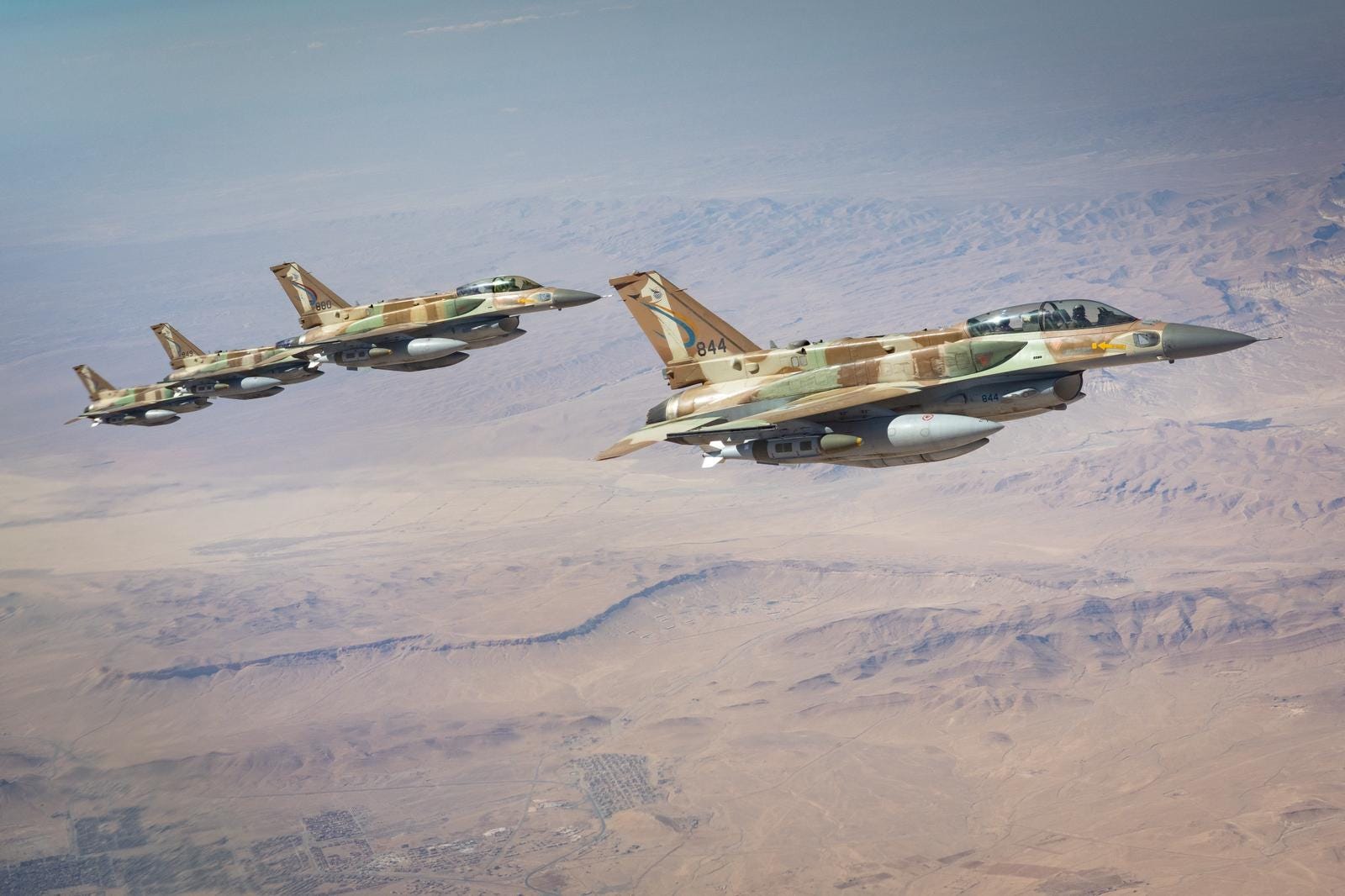
This pivots the game of attrition (Iran’s only play) on its head. Western weapons have become advanced, expensive and produced in low volumes; we discuss this often when it comes to the Russo-Ukrainian war. But once you have air superiority and strategic bombers are freely in play, the equations change drastically. Now, vast tonnage of accurate, but inexpensive munitions can be used. The US has massive stockpiles of these munitions, and your firepower not only gets more voluminous and cheaper, but also more powerful. Heavier munitions can now take out bunkers and especially fortified positions of the Iranian regime. Furthermore, large amounts of expensive and slowly-produced interceptors are no longer needed, if Iran can’t fire to begin with.
Despite plenty of misinformation to the contrary, Iran is losing this war fast, for those that it is not evident already. Now, some may be puzzled on why Iran has lashed out seemingly at everyone in the region. Missiles have been fired at all the gulf states (nor surprisingly, the most at the more right leaning UAE), at international shipping, and even British bases in Cyprus. Ironically the UK had even been denying US use of its bases for the operation until that point. Only two countries were attacking it and Iran lashed out at nearly every country in the region.
That may seem quite stupid. Well maybe but the truth is that the stupid was already long in the past. At this point, the regime does not have many options. All it can do is hope to cling on, and somehow outlast the fickle Trump who always loves a deal. Just like during the first round, the regime’s only chance at avoiding a complete defeat is Trump. And again, any new face leading the show can be played off as in fact a new regime making the deal.
But short of that, it hardly matters what Iran does or doesn’t do. And a regime fighting for its life, and having prepared for over thirty years for the eventuality, will fire everything its got, at everyone it can. The truth is that Iran is simply trying to optimistically enact the very strategy the various American Democrats, American doomers and Americana adversaries have been prophesizing. Iran too, drinks its own Kool-Aid. The idea here is that Iran must survive by fighting a war of attrition with the democracies of the US and Israel. Being democracies, they can be defeated by eroding popular support for the war. All they need to do is cause casualties, cling on to power, and cause as much economic havoc as possible.
We have long been told about the catastrophe Iran’s closing of the strait of Hormuz would be (the Iranians as I explained previously cannot close the strait nor much of anything else). So they are simply tying to cripple the world’s, or at least the Western, economy. By hitting oil, water and maritime infrastructure all over the region, they hope to bring shipping to a halt. If they are able to cut oil output from the region, and eliminate shipping within the gulf, for a significant period of time, certainly overwhelming pressure would force the US and Israel to back down.
This is why they have lashed out at everyone. Of course, the Iranians lacked the power to execute this strategy on day 1, and they are further away from it each passing day. As I mentioned before, their attempt at closing the strait would see their Navy sunk. In the event, it was sunk even before they made a believable attempt at a closure. Ships will continue to traverse the strait and the Persian Gulf, simply at increased insurance rates or without insurance. As a sign of situational awareness, I briefly read that the US will be offering not only Navy escorts to commercial shipping, but also war insurance in case the primate markets for it freeze up. That is a sign of thorough planning (what did I say Trump learned from the Maduro operation?!).
Ironically, the only part of the Persian Gulf that will see shipping fall to near zero, will be shipping to and from Iran. We already see this phenomena in action:
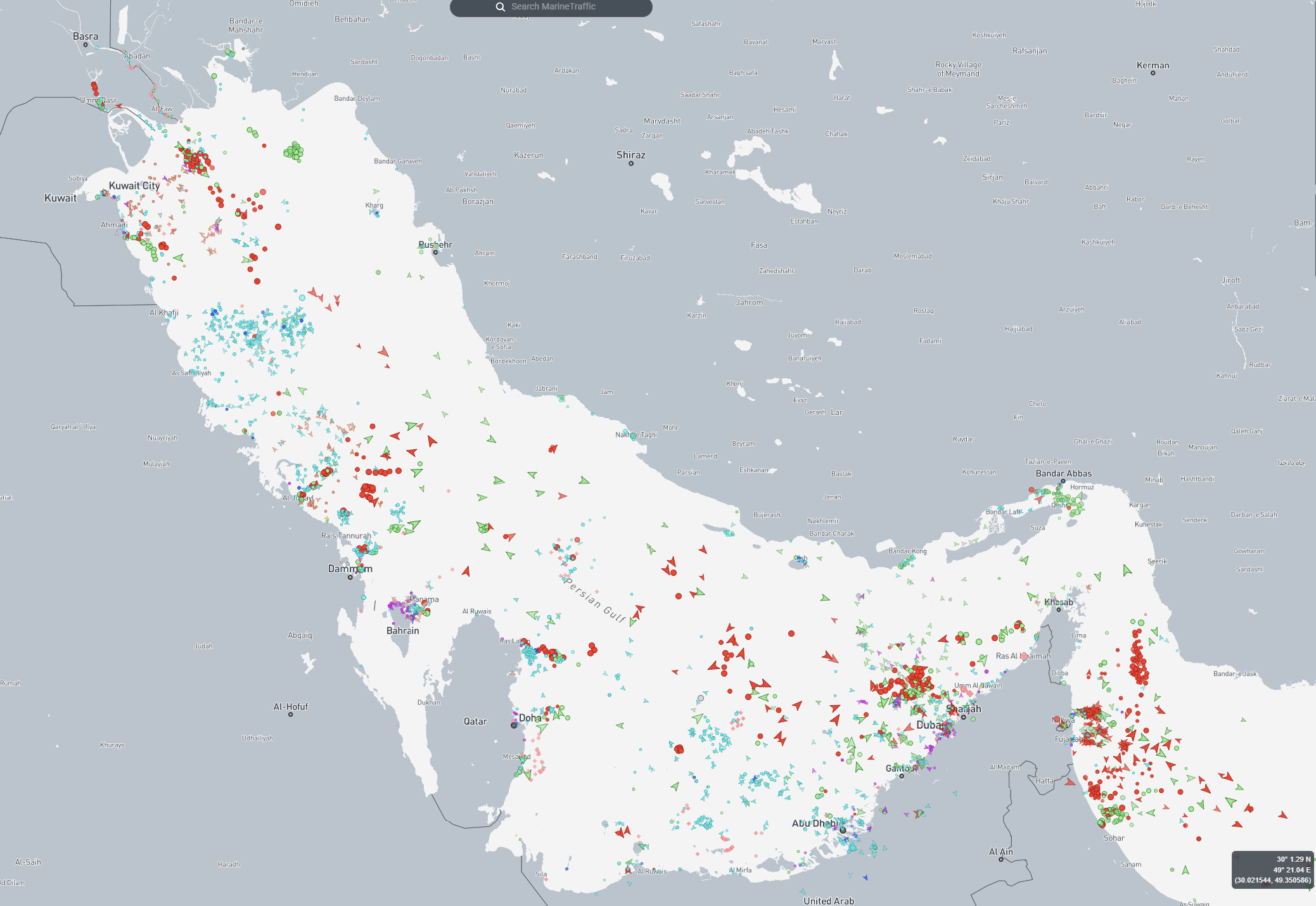
As you can see, it is the northern (Iranian) side of the Gulf that is virtually empty. Iran will be forced to make due with small ports on the Caspian for trade via Russia, and the land crossings of Turkey (dominated by the Kurds) and Pakistan (of very poor logistics, and dominated by the Balochis).
So what looks like lunacy in the lashing out at everyone randomly, and largely ineffectually, is just the anticlimactic poor execution of the strategy experts told us for decades would lead to catastrophe and at the least WWIII. Iran thought it would bring down the house, the price of having directly attacked the Iranian Revolution, would be complete chaos, destruction and economic collapse for the region and the world. Not so much. The seemingly absurd strategy is incompetence, ignorance and arrogance all at once and at full display.
Of course, as they realize the futility of their strategy given their limited and diminishing power, they may attempt to change tactics; since they are not really sowing chaos, why anger the region’s neighbors against them to no benefit? They may even waver back and forth on this strategy, as internal arguments rage on its efficacy, or issue statements that contradict its actions (saying they won’t attack their neighbors while doing so, or and/or vice versa). This would all be typical Iranian regime behavior. For what it’s worth, having angered the neighbors already and shown their true colors, only steadfastness gives them a chance, regardless of how small. Stopping attacks on their neighbors now will only remove any beneficial (to the regime) incentives on the Gulf states, and leave their wrath and desire for vengeance. It will also show weakness and that the regime is declining in strength, under stress and conflicted if not desperate. The Arab world doesn’t join team up with those showing those traits.
So what Next?
Having discussed the past, and the present military situation, we return to the pesky question of regime change. I maintained since the beginning of the previous 12 day war, that expecting the Iranian people to rise up against the regime while Israel (or America for that matter) was bombing them, in the short term was foolhardy.
If you hit them hard and fast, they would not be toppled during the fast strike, but perhaps down the road (as began to occur). They lost face, respect, credibility and the tittering economics came crumbing down. To this end if you seek regime change I recommended hitting the refineries (which they haven’t done in their belief that they are friends of the Iranian people and enemies only of the regime.. or at least in the attempt to convince them that this is so… hearts and minds).
But in the short term at lest, while you bomb them a popular uprising won’t occur. Now, as I said then, if you simply maintain an air campaign long enough, anything can happen. But it’s not a great strategy.
On the other hand, while we know that Air Power alone cannot win a war on its own (in terms of actually controlling land), “at least not yet” as I wrote in a 2014 article that is quoted in this earlier substack written shortly after Oct 7th 2023:

… it can be very effective when supporting forces on the ground, and those forces don’t have to be your own. We have discussed how the original post 9-11 Rumsfeld Afghanistan campaign was brilliant in its efficiency of force. No (regular) US boots on the ground. Simply by supporting the Northern Alliance, which still barely held on in the far north of the country, and giving them massive air support (by embedding with them the famous US Horse soldiers), they quickly overran Taliban-held Afghanistan. Holding it afterwards against the wishes of its majority Pashtun (Taliban) people is something else entirely, but the point is that nearly any determined force can advance and take vast swaths of territory from nearly any opposing force, however stronger, if backed by effective Air support enjoying complete Air Superiority.
If any such group actually takes to the streets or arms itself and concentrates, then it can receive air support and finish the job. People might be greatly surprised at how fast (especially in open country and rural areas) such an armed group can advance with air support and against a crumbling enemy, who cannot concentrate nor maneuver lest they be destroyed from the air. The key is that as I have consistently argued, a popularly supported armed Shia Persian group like that is unlikely to organically to spring up. But an inorganic one can certainly be created.
And an even less creative choice would be the already fairly militarized Kurds. Not only can you organize and arm them within Iran, as we discussed has probably been happening more intensely since the First 12-Day Round, but they can also be organized and armed in Iraq, where the US has vast influence and bases, and then can cross into Iran. A Kurdish force, supported by US Air Power could indeed advance far beyond its traditional Kurdish territory and even from the core of a force that marches into Tehran. What that would mean afterwards is hard to say.
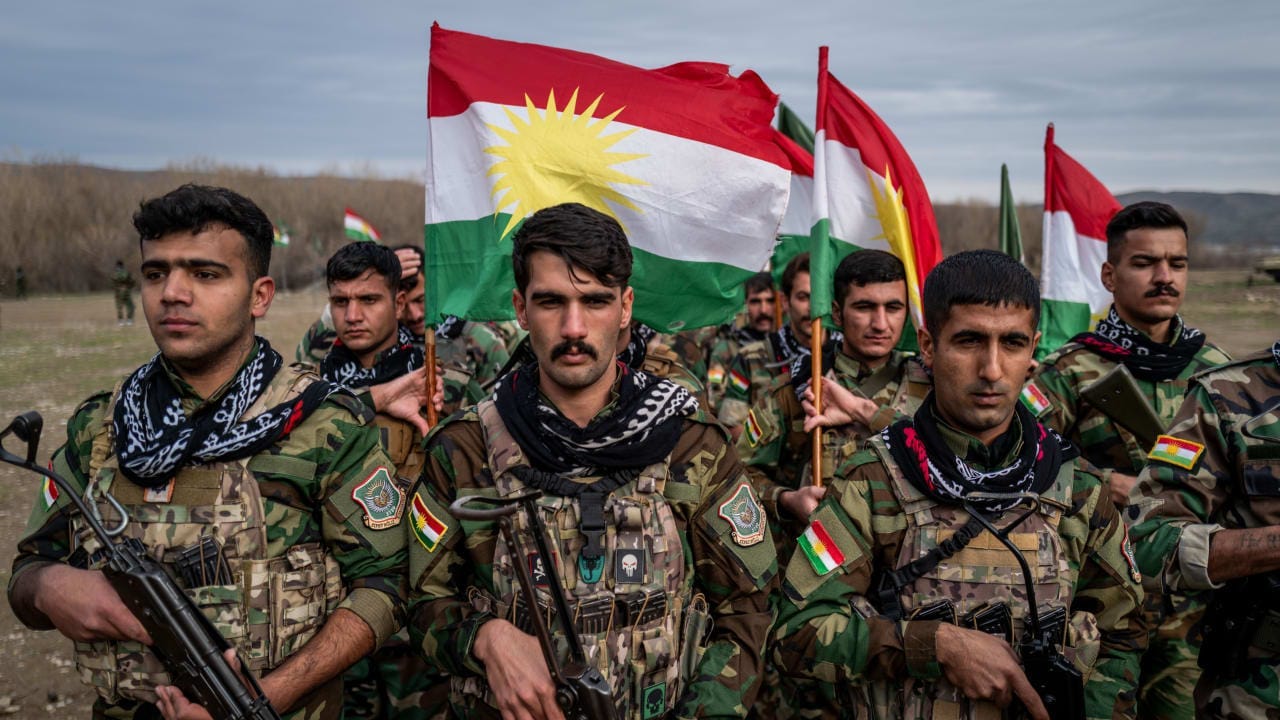
Unless the Kurds make a Reuben-Gad-Manasseh3 deal with the US in that they would lead the assault to topple the regime, and after victory would return to their lands, you likely would end up in a situation of endemic conflict as a vengeful Kurdish elite tries to rule over a terrified Persian population who would not accept Kurdish rule, unless exceedingly temporary.
In any event, whether Kurdish forces lead a core group that is later expanded to include many others, and advance onto Tehran (before inviting the Shah back?), or they simply establish their autonomy in the northwest, Turkey will vehemently and violently oppose them. The effective deletion of the Iraq-Iran border in the Kurdish regions (up until now, existing only by its forceful implementation by the regime), as supplies weapons and people cross back and forth while the regime loses control over it, will not only be difficult to re-establish once broken, but will in effect be the birth of Kurdistan.
Because unless Iraq is accepted to have grown and annexed parts of northwestern Iran (which no one will like or accept, even less so annexation in the opposite direction), then the flimsy facade of autonomy within an Iraqi federation goes by the wayside. No longer Northern Iraq, but an emerging Kurdistan will seek to include within its borders, Kurdish brothers in Turkey and Syria.
As if any more points of conflict were needed, Turkish incursions into regions held by such Israeli-supported Kurdish groups or emerging Kurdistan, will pit the two arch enemies against each other.
To summarize, unless the Israel / US plan is to stop after a clear military victory (which I prefer), simply enforcing an air campaign until there is an organic national uprising may turn out to be a long and dangerous waiting game. And unless a deal with a false “new” regime (post-Maduro Venezuela style) is the desired out come, then pro-active measures are likely needed.
These could be as simple as striking the right targets (we have discussed the fuel refineries and the prisons), and as grand as creating the first groups of organized opposition, which can be given air support as it grows and advances. It can also take the form of using Balochi and Kurdish forces which already exist to advance into Persian Iran under American and Israeli air cover. Azeri (and Lur) forces may turn out to be key as they are more integrated with the Persians at large. They also tended to back the Shah in earlier decades.
Which strategy is used will determine how fast and easily a new regime can take shape, how it can incorporate opposition leaders in exile, most importantly the former Shah’s son, Reza Pahlavi, and how stable it can be post military intervention.
Because its so messy among other reasons I prefer we (Israel) stayed out of nation building exercises in Iran, but I expect Israel and the US have quite an elaborate plan put together, since we concluded (or at least I argued) on our earlier piece that Trump delayed an execution of plain strikes in order to achieve something much grander. We shall see if it works and how well. At the end, war is ultimately a battle of wills. On the other hand I do look forward with honor at seeing a Kurdistan rise from amongst our enemies, and look happily to, if need be, help defend it from Erdogan and his minions.
For too long, and far too often, has the West betrayed Kurdish aspirations, and almost always in a feeble attempt to appease Turkey and in the hope of maintaining its false friendship.
More accurately, Bibi attempted to skillfully navigate 3 major obstacles and leverage one against the other. Firstly, internal politics in Israel were increasingly demanding appeasement at any price, even (or especially) surrender, in exchange for the return of the hostages. Hamas for its part, would not release all of them in one go, and certainly for not less than full withdrawal of the IDF and a guaranteed end of the war. This finally changed when Bibi ordered the attack on Hamas leadership in Qatar. The blow terrified Qatar who pleaded the US restrain the increasingly aggressive Israel. The price was forcing Hamas’ hand, which only Qatar had leverage over (its leadership, personal guests). This led to the second key parameter, Hamas would now agree to what it previously would not. Thirdly, Trump’s pressure was ratcheted way high, as he desperately wanted to declare end to all sorts of wars during the chaotic early days of his Presidency; a task that was proving more difficult than he thought. Bibi, who had never bent post Oct 7th, to the Biden administration, finally acquiesced but only by leveraging these three converging dynamics. He got more than what could have been reasonable expected from Hamas, thanks for the Qatari panic, was able to squash internal resistance by succeeding in returning the remaining living and dead hostages (while retaining control of about half of Gaza), and still made it look to Trump like he was breaking, against his better judgement, out of respect to him (Trump). The price offered by Trump was I thought then clearly among other things… “Do this and you (or we) can finish off the Iranian regime, Hezbollah, all of it!”.
At the outset of the Arab Spring, I correctly predicted that the Assad regime would be the most difficult to topple, and why that would be.
Reuben, Gad, and the half tribe of Manasseh made a pact with Moses. Having large heards of cattle, they preferred the lands east of the Jordan. They agreed that their men would cross over with their fellow tribes and help Israel as whole conquer the Promised Land. After having done so, they would return to their families and their cattle, keeping their lands east of the Jordan.